One of the rules regarding how the opening ceremony of the modern Olympic Games—based on legends about various games believed to have been played by the Greeks in Olympia in ancient times—should be conducted was established in 1921 by the International Olympic Committee, which oversees the organization of the Games on an international scale. According to the regulations published by the Committee, each participating country would march in a parade through the venue where the games were to be held, carrying a sign bearing the country’s name and a flag accompanying it, proceeding in sequence through the area where the games would take place. A note in parentheses within the regulations specified how the order of entry into the venue would be determined: “Countries proceed in alphabetical order.”
A minor adjustment was made to these regulations in 1949. Presumably to avoid confusion that might arise from the fact that the country we refer to as “Almanya” is known, for instance, as “Germany” in English but as “Deutschland” in German, it was decided that the opening parade in the ceremony would follow the alphabetical order of the host country’s language. Thus, while Germany would be placed according to the letter “G” in the parade order at the Olympics held in London, it would, let us say, participate in the parade according to the letter “A” at Olympics held in Istanbul. The idea behind such a practice is to eliminate the privilege created by a predetermined order by allowing the use of the host country’s alphabet. In this way, it is claimed that the regulation, by shifting to a relative application, is organized not according to the alphabet used by a single nation but according to a universal logic.
However, the first “glitch” regarding this rule—though it could have arisen in countries using the Greek, Arabic, or Cyrillic alphabets—strangely emerged at the 1964 Tokyo Olympic Games. Of course, Munich and Moscow had also hosted the Olympics before Tokyo. At the 1972 Munich Olympic Games, following Greece—which, as the legendary initiator of the Games, was designated to lead the parade at every Olympics—Egypt was placed second, and Ethiopia followed in third place. Still, for those familiar with the Latin alphabet version used in German, grasping the logic of this renders the resulting “glitch” invisible: in German, Egypt is called Ägypten; Ethiopia is called Äthiopien. Therefore, while this practice may not be very understandable for the Japanese or Chinese world, it is not seen as much of a “glitch” either. Similarly, in the order of the 1980 Moscow Games, Austria follows Greece, and Afghanistan comes after Austria. However, this too is regarded as a matter easily understood by those who know that the third letter of the Cyrillic alphabet, “в” (pronounced “v” in the Latin alphabet), comes before the 22nd letter, “ф” (pronounced “f” in the Latin alphabet)—that is, by those who can read an alphabet—and thus the “glitch” once again becomes invisible.
However, how the order would be determined according to Japanese writing is not a situation that can be easily understood by those familiar with the idea of an alphabet. Because the Japanese writing system, as a version of the Chinese writing system, possesses a distinct character, the possibility arises that the parade might, for the first time, be organized using a “non-Western” and even a “non-alphabetic” form of writing. The Japanese overcome such a “glitch” by determining the order in the parade according to English rather than Japanese. In other words, the order is arranged according to the country names in English. However, the expressions “non-Western” and even “non-alphabetic” are significant here and bring the issue of an alphabet problem to the forefront.
Of course, a confusion is observed at the 1988 Seoul Olympics: Greece is followed by Ghana and Gabon. However, probably due to the scale of China’s investment in the Games, the “alphabet problem” is brought to public attention for the first time at the 2008 Beijing Olympics. That is, beginning with the broadcasting organizations airing the ceremony, the press starts, for the first time at the Beijing Games, to speculate on what the expressions “non-Western” and “non-alphabetic” actually mean. Thus, the Beijing Olympics are remembered in Olympic history as the first Games held in a country whose writing system is “non-alphabetic”—that is, the first Olympics in which the parade did not proceed according to the alphabetical order of countries.
Of course, in this presentation, while the ordering system observed in previous Olympics had, at least for Western eyes, a structure that could be understood, the fact that the system applied in Beijing was entirely unique also plays a role. To illustrate through the example of Turkey, our country enters fourth in the parade at the Beijing Olympics—after Greece (which enters first as the legendary organizer of the Olympics and thus the so-called original owner), Guinea, which enters second, and Guinea-Bissau, which enters third. Turkey is followed by Turkmenistan and Yemen. The sequence then continues with the Maldives, Malta, Madagascar, and so on. To make the issue clearer, let us say that Jamaica in 19th place is followed by Belgium in 20th place; and Andorra in 90th place is followed by Tonga in 91st place. In other words, if we look, for instance, at the first seven entries, the sequence proceeds as G, T, Y, M according to an alphabetical order. But why was such an order established?
The Chinese Olympic Organizing Committee, with the approval of the International Olympic Committee, decides to adopt a practice that has been known in China for centuries in the writing of country names in Chinese characters. Accordingly, countries are ranked based on the number of brush or pen strokes required in the rendering of their names in Chinese characters. For example, Turkey’s name in Chinese characters is written as 土耳其 (Tu’erqi): the first character, 土, which produces the “tu” sound, requires three brush or pen strokes. Consequently, Turkey requires more brush or pen strokes than the character 几, which produces the “ji” sound at the beginning of the Chinese rendering for Guinea, 几内亚 (Jineiya), and which requires two strokes. For this reason, Turkey is placed after Guinea in the ranking. Nevertheless, this criterion for ordering is also insufficient. Because the Chinese rendering for Yemen, 也门 (Yemen), also contains three strokes. So how, then, should the ordering be determined?
According to a principle claimed to have been traditionally used in China, the total number of brush or pen strokes required to form a Chinese character—eight in total—is adopted as a second criterion for ordering. The total of eight stroke types consists of dot, horizontal, vertical, left-falling diagonal, right-falling diagonal, rising, downward- or right-curving, and hook-shaped strokes. Accordingly, the Chinese renderings of country names are arranged by also taking into account their features within this principle. In this sense, since the “tu” (土) component in Turkey’s Chinese name consists of horizontal, vertical, and horizontal strokes, and considering their positions in the ranking, a 2-3-2 hierarchy is observed; whereas Yemen’s “ye” (也), consisting of downward-curving, vertical, and downward-curving strokes, corresponds—according to the ordering in the principle—to a 7-3-7 hierarchy. In this sense, since the name “Turkey” comes before the name “Yemen,” Turkey appears before Yemen in the parade.
It should also be noted that if, instead of resorting to a system claimed to be traditional for such an ordering, the Chinese Olympic Committee had adopted, for instance, the Pinyin system—which organizes Chinese ideograms or characters according to the Latin alphabet—the sequence would have taken on an entirely different arrangement. Of course, it should also be remembered that there are various alternatives to the Pinyin system; however, in an arrangement based on the Pinyin system, Ireland—written as Aìěrlán after Greece—would have been in second place instead of 159th; Ireland would have been followed by Egypt, written as Aījí, and Ethiopia, written as Aīsāiébǐyà, which are currently ranked 146th and 147th. However, the Pinyin system—developed by Chinese linguists nearly a decade after the Chinese Communist Revolution; generally referred to as “characters,” though sometimes described as ideographic; possessing a field of use parallel to Chinese writing; regarded not as a “Chinese alphabet” but as the use of Chinese in harmony with the Latin alphabet; and whose emergence is also connected to the history of developing a phonetic alphabet that began with modernization in China and therefore requires separate consideration—already contains an arrangement based on the Latin alphabet; thus, the logic would once again return to the logic of the alphabet, and China’s “non-Western” and “non-alphabetic” characteristic might not have attracted attention.
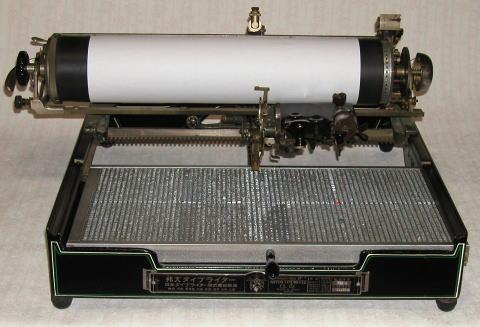
From this perspective, the fact that the Chinese arrange their own written characters according to what they claim to be traditional brush or pen strokes (there will, of course, be those who argue that this alienates China from the global public; however) should be seen as a subtle and cunning move displayed at the opening of an Olympic Games watched by millions around the world. From this perspective, what needs to be noted is that—setting aside the question of what a Chinese typewriter might look like, which is difficult to imagine for those who use the Latin, Arabic, Cyrillic, or similar alphabets (though not for those who use hieroglyphic writing, as we will return to later)—in a technological field calibrated to the Latin alphabet, ranging from Morse code to all kinds of software that are extensions of Turing machines, and from computer codes to optical scanners, China chose to present itself at the Olympics as a country “without an alphabet” in a way that prompts curiosity about what and how the Chinese actually do things. This does not resemble wondering how the Chinese, Koreans, Japanese, or speakers of languages with distinct characters (such as Filipinos who use the Tagalog script) are able to send these messages in brief communications.
Indeed, how do nations without an alphabet adapt technological products that require software to their own writing systems? Being “non-Western” may perhaps be understandable; but what does “without an alphabet” mean?
Answering this question by invoking the concept of globalization, as is generally done, would be an oversimplification, despite the fact that technological software is of Latin origin. A brief investigation may show us that, despite all these different characters, a Chinese typewriter does indeed exist. However, this is not the real question; the real question is how those who possess an alphabet imagine those “without an alphabet,” and what this truly means. In this sense, claiming that China has begun to adapt to informational developments by leaving Chinese characters behind is another form of oversimplification. Clearly, the Chinese are able to adapt themselves to such technologies with ease. Moreover, such oversimplification is not new when it comes to Chinese characters and can, for instance, be traced back to Leibniz’s thoughts on China.
Therefore, to view the demonstration of techno-linguistic skills by the Chinese or other “non-alphabetic” peoples as the emergence of a new and “universal” system—independent of any language—triggered by globalization is akin, in a way, to Heidegger’s writing of Being with a strikethrough because he could never fully grasp it within language, to his writing of Being as such in order to show it beyond mere presence; and to Derrida’s attempt to render the gaps or absences within writing a part of grammatology; it resembles, along with Chinese characters, the erasure of all writing systems, whether alphabetic or not. From writings on the history of the Chinese typewriter, we can readily see, for example, that the failure of brands such as Remington and Olivetti to enter the Chinese market stemmed from the difficulty of imagining a Chinese typewriter; and that this, in turn, served to conceal the techno-linguistic skills of the Chinese.
There has never been an “alphabet universalism”; acting as if there were should be regarded as equivalent to assuming that the “alphabet” has been universalized. Especially in information technologies, which have come to be referred to as “communication,” the fact that imagining—and even implementing—a Chinese typewriter appears not merely difficult but impossible, and that certain prototypes designed by renowned typewriter companies were not found usable by the Chinese and could not be used by them, is not an issue that can be resolved simply by saying, “because the Chinese have no alphabet.”
Because—even if not in a pandemic sense—there is no “virus” in China in terms of coding; and claiming that all “viruses”—whether those that paralyze computers or are coded as tools for theft—are “alphabet”-based is equivalent to this; thus, considering how the coronavirus spread from China to the entire world, it reveals the absurdity of, for example, U.S. President Donald Trump calling this virus the “Chinese virus.” If there is no “alphabet” in China, and if the programming languages used in technolinguistics are also “alphabet”-based, then there cannot be a “Chinese virus.” But we know that this is possible. Classifying writing systems into three categories—alphabetic, ideographic, and pictographic—as is generally done today is also a form of “alphabet” logic.
At the very least, in order to tie the subject together within the context of this text, it may be appropriate to compare the Chinese arrangement of the opening ceremony lineup of the Beijing Olympic Games—based on their own characters under the guise of a supposedly traditional practice—with the expression on the face of German Chancellor Friedrich Merz during a performance staged for him during his visit to China in February 2026. The Chinese delivered their message to the world at the Olympic Games: We have no alphabet; we write our script with characters formed by brush or pen strokes. This, of course, may constitute a source of astonishment for those with an “alphabet” and even serve as a basis for a new attempt at exoticization, frequently encountered in missionary reports or travelogues from the Enlightenment period.
However, during the performance staged for him on his trip to China, as “robots” designed in a “humanoid” manner put on a show, there was more on Merz’s face than the expressions of a Western tourist visiting the Great Wall or the Forbidden City. When considered with a sober mind, the “robot” performance—which could be likened to a high school student’s show who, if given the opportunity, might draw the Turkish flag in the sky with drones—gave rise to signs on Merz’s face that reflected astonishment and bewilderment alongside a smile, curiosity, and interest. It is also possible to find similar themes behind the supposed difficulties of imagining that the parade at the opening of the Beijing Olympic Games was organized by those “without an alphabet,” or even of envisioning a Chinese typewriter.
This can generally be described as the difficulty of imagining China as possessing an “alphabet,” or even the difficulty of attempting to conceive China through frameworks such as human rights, democracy, the rules necessary for an international order, and similar constructs.
* Photo: A cartoon of a “Chinese typewriter” published in Life magazine in 1927
Thinking of China as a “Fake”
The first possibility that comes to mind when one cannot imagine a Chinese typewriter, yet considers the possibility of its existence, is that if such a typewriter—one actually used by the Chinese—does exist, it might be a “counterfeit.” Here, “counterfeit” carries meanings beyond simply being a copy created by imitating an existing “original.” A “counterfeit” is, of course, an “imitation”; however, it is an “imitation” made without permission from the “original”—one might say, without “copyright”—and thus created without authorization.
The history of evaluating China as “counterfeit” is often associated with the invasion of Western markets by almost identical copies of original products. Yet perhaps its earlier background should also be investigated; however, even before “counterfeit” products flooded the markets, when one looks at the logic of the debates that took place on the eve of Hong Kong’s handover to China in assessments about China, it can be said that a “counterfeit” issue was already in effect. Around the 1990s, when I was still an undergraduate sociology student, that is, roughly a decade before Hong Kong’s handover to China, I realized—quite recently, in fact—that in a class whose name I can no longer recall, probably while discussing the transmissibility of modernity, our discussion of the consequences of Hong Kong’s transition from being a British colony to Chinese sovereignty was grounded in a “counterfeit”-based framework. Roughly speaking, the focus of the discussion was a kind of brainstorming centered on the possibility of whether, after the handover, China would influence and transform Hong Kong, or whether Hong Kong—which had long remained under British rule and thus had emerged as an example of British capitalism on the edge of the Chinese mainland—would instead transform China. To this debate, which also constitutes the main subject of the works of the China modernization expert Arif Dirlik, who passed away last year, it is now quite possible to respond by saying that China has in fact established “counterfeit” Hong Kongs in Beijing or Shanghai. However, this response cannot easily evolve into the possibility that Hong Kong has transformed China. That would amount to turning Hong Kong, in one way or another, into a miniature of an ancient China. At the level of discourse, the counterpart of this opposition is that, for the Chinese, Hong Kong is a corrupt representative of Western culture open to liberal free trade, whereas for Westerners it corresponds to a free trade zone that has never fully become Western and ultimately represents a conservative Chinese mainland—which, in the end, is akin to imagining a Chinese typewriter for a nation “without an alphabet.”
A reflection of this analogy is the effort to explain “counterfeit” together with a deeper and more traditional Chinese culture. For example, the work of Byung-Chul Han—who, for some reason, is very popular here (though do not take my saying “for some reason” at face value; his tendency to produce works on almost every subject as if they were pills perhaps reveals a kind of ease that could be evaluated under the heading of “counterfeit”)—titled Shanzai: Dekonstruktion auf Chinesisch, written in German on the notion of “counterfeit” in China, is translated into Turkish as Çakma: Çince Yapıbozum. In other words, in the translation, the expression “Shanzai,” which is actually present in the original, is not preserved, and through a “counterfeit” operation it is rendered as “Çakma.” Although this initially appears creative, the situation becomes even more complicated when, in the English translation of Han’s work, the expression “Shanzai” is preserved as it is, yet the word is translated as “fake.” As is well known, “fake” is a term with excessively negative—even malicious—connotations, used quite frequently especially in the media sector in Donald Trump’s country, and it is closer in meaning to “forgery.”
On the other hand, Han’s explanation of Shanzai is also complicated. It is as if, on the one hand, the effort to capture the original of a word in Chinese that means “counterfeit,” that is, to present what the original of the “counterfeit” is, and on the other hand, the attempt to reimagine a “counterfeit” that already has an original in Chinese under Western eyes, have made his analysis more complex. For this reason, he first offers an analysis of “counterfeit” for Western eyes and, in doing so, uses China as if it were an ethnographic field. Accordingly, “counterfeit” (or “fake”), Shanzhai (山寨) in Chinese, is a new or fabricated word (a neologism). In addition, it has a wide range of usage that can be expressed through terms such as “shanzhaism,” “shanzhai culture,” or the “shanzhai spirit.” Indeed, “Shanzhai has permeated every aspect of life in China today. There are shanzhai books, a shanzhai Nobel Prize, shanzhai films, shanzhai politicians, and shanzhai stars.”
However, according to Byung-Chul Han, the Chinese first encountered this newly coined term in the field of mobile phones. Accordingly, shanzhai mobile phones were used to refer to products that imitated brands such as Nokia or Samsung and were released under names like Nokir or Samsing. Nevertheless, Han draws attention to a point—one that he will later use not for Western eyes but as a basis to demonstrate the very essence of “counterfeit” in China: “Yet these cannot be regarded as crude forgeries.” On the one hand, shanzhai products “are by no means inferior to the original in terms of design and function. Technological and aesthetic modifications give them their own identity.” On the other hand, these products—which possess both “counterfeit” and “their own identity”—have a level of “flexibility” that goes far beyond even the originals they copy. Indeed, owing to this characteristic, they possess the capacity to respond immediately and swiftly to new and specific needs that original products cannot easily adapt to “over long production periods.” In other words, shanzhai products have qualities that surpass the originals they copy and fully exploit a potential. Han calls this a “true Chinese phenomenon” and believes that it represents China.
What is interesting is that these “counterfeit” products—which are in fact “fake”—also include applications that can, for example, immediately detect counterfeit money. For this reason, they possess “original” qualities. This aspect does not only involve the presence of certain applications or features in “counterfeit” products that are not found in original products and their easy and rapid integration into products; it also becomes the essential characteristic of a shanzhai product: “Shanzhai exhibits a distinctive form of creativity. Shanzhai products gradually diverge from their originals until they transform themselves into a distinctive creativity.” However, at this stage of conveying shanzhai to Western eyes, Han prefers to present this feature merely as a change of name: “Adidas becomes Adidos, Adadis, Adadas, Adis, Dasisa, and so on.” For this reason, Han sees the originality of such “counterfeit” products that copy the original as “a genuine Dadaist game that not only fosters creativity but also mockingly and destructively affects the positions of economic powers and monopolies” (pp. 79–80).
However, Han’s analysis suddenly changes direction at this stage. In a way that prompts one to question the authenticity of what he has said above and to ask whether they should be regarded as a “counterfeit” analysis, he turns to the original meaning in Chinese of shanzhai, which he had described as a neologism: “The literal meaning of shanzhai is ‘mountain fortress.’” Here too, Han makes an interesting move and first interprets the “mountain fortress” within a framework that mocks state power—one might say, forming a “true Dadaist game.” Accordingly, there is a famous novel called Water Margin (shui hu zhuan), and in this novel, which depicts the Song dynasty period, “outlaws (peasants, officials, merchants, fishermen, officers, and monks),” that is, nearly every segment of the population, hide in “a mountain fortress to fight against a corrupt regime.” Han first explains this situation within the context of “shanzhai culture”: “Even shanzhai examples on the internet that satirize state media controlled by the Party are interpreted as subversive acts targeting the monopoly over freedom of thought and representation.” However, he immediately abandons this explanation and claims that interpreting “shanzhai culture” in this way rests on the “hope that it could eliminate the power of state authority at the political level and release democratic energies.” Yet the fundamental characteristic of shanzhai is not an “anarchic-destructive” one, but rather a “playful-creative” character.
It is precisely here that we arrive at a clear understanding of what shanzhai actually means in China. Because the novel Water Margin is in fact authorless—that is, it has no author; it is anonymous. This does not mean that it is anonymous simply because its author is unknown. The novel’s mode of composition requires that its author be unknown. Because the novel, which has many different editions—say, one edition may contain 70 chapters while another contains 120—the stories in each chapter were written by different people, and the structure of the novel is thus formed both through editions containing variations in chapters and through the stories in each chapter being written by different individuals. This, in fact, is exactly what shanzhai is: “In China, cultural productions are generally not attributed to any specific individual. Most often, they have a collective origin and do not exhibit forms of expression associated with individual, creative genius.” Precisely for this reason, not only the novel Water Margin but also works such as Dream of the Red Chamber or The Story of the Three Kingdoms have been rewritten time and again, and with each rewriting, the structure of the novel has changed. Indeed, while one version may end with a tragic ending, another version may easily end with a happy ending. This applies not only to classical works but also to the editions of Harry Potter published in China. In the Chinese editions, Harry Potter may acquire Chinese friends; he may speak Chinese with ease and eat with chopsticks.
Thus, Han establishes a principle for shanzhai. Although he offers an analysis that draws the reader into a whirlpool by first stating that the word is a neologism, then explaining that it contains a playful “destructive” act against authority found in classical literature, and finally asserting that it is in fact a method through which classical Chinese literature produces and even reproduces itself, he nevertheless states that shanzhai—which he defines as “counterfeit” (fake) and presents as a general characteristic of China—does not aim to “deliberately deceive” through either its commercial or literary “products”: “In reality, beneath their appeal lies the fact that they specifically draw attention to the truth that they are not original and that they play with the original work” (p. 81; translation slightly modified).
But if that is the case, shanzhai is not “counterfeit.” It is a distinctive (one might say) mode of production. Nevertheless, Byung-Chul Han, a writer from Seoul, Korea, who writes in German, finds this playful character inherently deconstructive: “Shanzhai’s game of fakery inherently produces deconstructive energies. Shanzhai label design also carries humorous traits. On a Shanzhai iPhone, the label looks as if it were a slightly worn iPhone label.” This, in turn, gives rise to a principle regarding shanzhai: shanzhai products, with their undeniable creativity and playfulness, are defined not by the rupture and suddenness of a new creation that severs its ties with the old, but by the playful pleasure found in modifying, diversifying, combining, and transforming the old. This, in fact, reveals another characteristic of shanzhai alongside its inherent or original “deconstructive” nature: the characteristic of “process and change.”
As can be understood, the “deconstructive” character here is not exactly the deconstructiveness associated with Derrida, who is known as the originator of deconstruction (because in China, deconstruction, by virtue of its spontaneous existence, predates even Derrida’s deconstruction). However, “process and change” belongs to another Western approach that seeks to understand Chinese thought as a process and change without a creator. The most distinguished example of this can be seen in François Jullien’s work Process or Creation? An Introduction to the Thought of Chinese Intellectuals, which has also been translated into Turkish. In other words, while the Korean Byung-Chul Han presents us with a Chinese “counterfeit,” he cannot refrain from connecting it to two different traditions in the West. Jullien’s evaluation of Chinese thought as a “process” that takes place solely through interaction with one another, without any essence, substance, origin, or core, may perhaps be addressed in a different context; however, it is in fact interesting to say that a method of reading pioneered by Derrida exists in China spontaneously or by nature, and this is, as we will briefly touch upon below, connected in some way to such a notion of “process.”
Of course, Derrida—known for being attentive to the conditions under which his own works emerge and to the “signature” affixed to them—developed this method (even if not in the same way as in the Chinese novel Water Margin) through various concepts he drew from a certain tradition; for example, in connection with the concept of destruction (Destruktion) that Heidegger employed in Being and Time in his attempt to dismantle Western metaphysics from within, on the basis of its own foundations, and to reach the origin of the question of Being. In other words, in Derrida’s deconstruction as well (not only Heidegger), there is a tradition extending from Plato to NATO. The only difference between this and the Chinese “process” and thus the logic of shanzhai—that is, the logic of the “counterfeit”—is that Derrida is engaged with a history of philosophy and, accordingly, with the philosophers who constitute this history, and that these philosophers are not anonymous or unknown.
Considering the historical emergence of deconstruction as a method of reading employed by Derrida, it may, in this respect, seem interesting to find an inherent deconstructive quality in Chinese “appropriation.” However, the fact that Han’s book Shanzhai: Deconstruction in Chinese, which begins with Hegel and his reflections on China and the Chinese, ultimately concludes, in its final chapter on “shanzhai,” with a Hegelian act eliminates this interest. Han’s “shanzhai” is a Sinicized form of Hegelianism, because Han, who begins his book by referring to Hegel’s writings on the Chinese people’s propensity for “lying,” and who also notes that Hegel attributes this “great immorality”—that the Chinese have “gained a notorious reputation for deceit wherever they find an opportunity”—to the fact that their consciousness has been shaped by “pure Nothingness,” ultimately arrives at the same point by portraying a Chinese mode of thought that is not the creation (or, if one prefers, cautiously speaking, the genesis) of any such “process” that constantly modifies, composes, diversifies, alters, and transforms itself in relation to what precedes it, and that therefore has no “original,” and thus operates as an always deconstructive “process”: in fact, in Chinese thought, there is no “essence (ousia)” that is permanent and thus gives shape to the “process,” nor is there such an “essence” underlying all change and development within the “process” for the “process” to take shape in its image. For this reason, the “counterfeit,” while copying that which has an original, imitates it as though the original did not exist at all, and the “process” proceeds as if it were the Way (Dao). The trajectory of the spirit of that which has an “essence” is not the same as that of the spirit of that which does not have an “essence.” (As Han also emphasizes in his discussion of the Chinese term “zhen ji,” which, at least in the context of a work of art, means “original,” in connection with “truth,” in China “a work of art is empty and flat within itself. It is devoid of spirit and reality.” That is, it develops upon a “void” that lacks essence or substance.)
As can be understood, we have arrived at a point similar to that of the “non-alphabetic.” “Counterfeit” also suggests that there may be a Chinese-style logic of sequencing in China; while it involves the copying of a product that has an original in Western eyes, it can take shape as another kind of “process” within itself—a “process” in which that which has no original constantly modifies itself.
But what does the “counterfeit” of China deconstruct? We will address this in the next article while discussing the efforts to transition to an alphabet in “alphabet-less” China and the attempts to give a “voice” to “voiceless China.”
Reading China as “Voiceless” and “Scriptless”
Born in 1881 and died in 1938, Lu Xun—regarded by some as the second most important figure in modern China after Mao, and praised by Mao not as a great writer or literary figure but as a revolutionary—has a famous essay titled “Voiceless China” (“Voiceless China”; “Wushengde Zhongguo”), which is considered one of the cornerstones not only of modern Chinese literature but also of modern Chinese thought. Interestingly, the speech “Voiceless China,” the text of a talk delivered at the Hong Kong Young Men’s Christian Association (Hong Kong YMCA) on February 16, 1927, was given during a time when conflicts between communists and nationalists were ongoing. Although he never explicitly professed Christianity, Lu Xun—who is said to have been well-versed in Christian literature and the Bible and to have had many Christian friends—also touches upon these conflicts at the very beginning of his speech. However, his subject is entirely different. Lu Xun is of the opinion that China has no “voice.”
Here, “voice” is in fact directly related to “writing” as well; it is not merely about having a say in the face of political developments or the pervasive influence of modernity. For Lu Xun believes that the Chinese lack a “writing” that would serve as a means to “convey their thoughts and feelings to a broad audience.” Because the Chinese do not possess a “writing” suited to the conditions of the day, they are in a “voiceless” state. However, this is not a “fault” of his own generation; for “our written script is a dreadful legacy left to us by our ancestors. Even after years of effort spent learning it, using it correctly remains very difficult” (for Lu Xun’s essay “Voiceless China,” see Jottings Under Lamplight, edited and translated by Eileen J. Cheng and Kirk A. Denton; p. 165).
In fact, it can readily be seen that Lu Xun employs arguments similar to those we know from the alphabet debates that began with the Tanzimat in our own historical context; however, he does not actually propose a direct change of alphabet. What he proposes is a reform that will bring China to a “civilized” “voice” in the face of the fact that “even though China possesses a writing system, it has become irrelevant to the majority of the people.” Because (as a contrast that will also appear in later writings), “the primary difference between the civilized and the barbarian is that the civilized possess a writing system and are able to use it to convey ideas and emotions to the masses and to future generations.” Moreover, although there are discussions about China conducted by other countries, Lu Xun also possesses a nationalist sentiment to the extent that he complains that “China’s voice” is not heard in these discussions. China must free itself from being “voiceless” and find its “voice”. “We have a people, but we have no voice, and we feel alone.” The problem is not merely being “alone.” Because the “voiceless” are “dead”: “Is it possible for a people to live without a voice? If a people has no voice, we can say that it is dead.”
What, then, is Lu Xun’s solution to revive this “voiceless” people who are almost “dead,” if it is not a direct change of alphabet? “We no longer need to direct all our efforts toward learning the language of the ancient, dead people; on the contrary, we must speak the modern language of the living. We do not wish to treat language as an antique; we want to write it in an easily understandable spoken language [vernacular].” These are themes that can easily be seen, for example, in Ömer Seyfettin’s writings on “language,” and like him, he seeks to base his approach on the spoken language found in the “living” mind and “living” life of the people: “If we wish to revitalize ourselves, the first thing we must do is ensure that the young stop speaking the language of Confucius, Mencius, Han Yu, and Liu Zongyuan” (p. 168). We know Confucius mentioned here; the others can be replaced with our own writers who used Ottoman Turkish. In short, Lu Xun calls for the abandonment of the traditional language—heavy, no longer connected to modern life, and already considered detached from the life of the time in terms of its subject matter—and a return to the simple and plain spoken language of the people.
Therefore, the fact that Chinese writing uses characters and is ideographic does not seem to pose a problem—at least in the context of this essay and on the surface—for Lu Xun, who is also in favor of the alphabetization of Chinese writing. Here, Lu Xun appears to take a middle path between ancient Chinese writing and alphabetization. Because his main concern is not a “literary revolution,” but rather “literary renewal.” In China, “as soon as the call for literary renewal was voiced, a counter-reaction emerged. Yet the local language gradually became popular and encountered very few obstacles. What was the reason for this?” The reason was, in fact, the reaction against those who advocated “the abolition of Chinese writing and its replacement with the Latin alphabet.” The Chinese – as if recalling Geoffrey Lewis’s characterization of the alphabet reform in Turkey as a “Catastrophic Success” – considered the Latinization of Chinese writing to be “a catastrophe” since they thought it would be “a real disaster,” and in response, they consented to a “literary renewal” based on the “spoken language.” In other words, “the spoken language [vernacular] used by the people took advantage of this opportunity and, unexpectedly, reduced the number of its enemies and triumphed by overcoming the obstacles before it” (p. 167). It is within this framework that Lu Xun argues that by taking the spoken language used by the people as the basis, the “voiceless” Chinese can gain a “voice”: “Young people must first transform China into a China with a voice. They must speak boldly, forge ahead boldly, set aside their personal interests, set aside the ancients, and express their true feelings” (p. 169).
Lu Xun’s essay is interesting in several respects. To state the most important point for our purposes by saving it for last: this shows that there is also a movement for alphabet reform in China, and that this is independent of the efforts of the Jesuits, and subsequently Protestant missionaries, who, being unfamiliar with Chinese writing, sought—according to their own logic—to develop new writing systems in order to convey the Bible to the Chinese. These efforts are carried out by the Chinese themselves. However, there are significant differences between the attempts ranging from the phoneticization movement known as fanqiu at the very beginning of the Common Era, to the phoneticization inspired by Sanskrit during the Tang dynasty – which corresponds to the Middle Ages in Europe –, to the efforts of missionaries, and then to the phoneticization undertaken by the Republic of China established after the 1911 Revolution, and finally the phoneticization efforts of a period that may be termed “alphabet universalism.”
“Alphabet universalism”—that is, phoneticization within a framework in which a Western writing technique and the linguistics based upon it are taken as central—has two important phases (as emphasized in Yurou Zhong’s Chinese Grammatology: Script Revolution and Chinese Literary Modernity, 1916–1958), and these can be regarded as important stages in the transition from phoneticization to grammatology. The first phase in fact corresponds to a general period of efforts observed worldwide to shift to the Latin alphabet. This alphabetization initiative—which overlaps with our own period of alphabet reform, but also with efforts to alphabetize the Russian Cyrillic alphabet, the writing system known as chữ nôm written with Chinese characters in Vietnam, and the Japanese kana system—was also supported by the nationalist Chinese government. However, not only nationalist Chinese, but also—likely encouraged by the initiatives of Soviet authorities who compelled the Turkic communities they occupied to adopt not the Cyrillic alphabet they themselves used (and had at one time considered changing), but the Latin alphabet—Chinese communists also supported efforts to alphabetize Chinese writing; yet these efforts did not develop everywhere as expected. Of these efforts, only Turkey emerged with “catastrophic success.” The Soviets ultimately settled on the Cyrillic alphabet and directed the Turkic communities under their occupation—whom they had previously encouraged to Latinize—to write in Cyrillic as well. The Vietnamese example was partially successful; however, this was largely due to the adoption of a writing system called quốc ngữ (national language), which had been developed by Western missionaries as early as the seventeenth century on the basis of the chữ nôm system.
In China, however, Latinization efforts aligned with “alphabet universalism” failed to break the dominance of Chinese characters. Nevertheless, the “linguistic” evaluations put forward through the organizations and publications established by Chinese who had emigrated to or traveled to the United States for educational purposes—particularly studies influenced by an Anglo-French linguistics resembling French structuralist linguistics, which, as exemplified by Ferdinand de Saussure, marked a break from the German philological tradition and still occupies an important place in linguistics today—left traces regarding how Chinese and Chinese writing were perceived. Thus, a general acceptance emerged that phonetic writing constitutes an ideal system for linguistics. Put briefly, the understanding of writing as a visualized sign of a “sound” produced by the mouth led to the placement of Latin script at the very top of a hierarchical ranking of writing systems. The underlying motive behind the alphabetization initiatives in China, therefore, was this hierarchy that prioritized Latin and, consequently, the “alphabet.” Those who sought to transform Chinese writing into an alphabet aimed to eliminate an ancient Chinese script and to modernize it by turning the spoken language into a written language. Transitioning to an alphabet also meant democratization, liberation, and revolution.
However, the second phase is more intriguing, and although it is again based on a trend felt on a global scale, it relies neither on the theses of “alphabet universalism,” nor on the positive qualities of the “alphabet” identified with the Latin alphabet, nor on certain linguistic criteria. The announcement in 1958 that an alphabetization initiative—which had been dominant among Chinese intellectuals and, whether nationalist or communist, among political elites in the first decades of the twentieth century—was officially terminated, and the declaration that, apart from minor simplification efforts, writing would continue in a system belonging to ancient China, is not a purely linguistic decision. In fact, the communist administrators who had, through revolution, transformed the nationalist Republic of China into the People’s Republic of China made a strategic decision that deserves consideration at least as much as, if not more than, the Chinese Revolution itself. Behind this decision, the emergence of a Non-Aligned Movement—if not as an alternative to, then alongside, a bipolar world order that had begun to take shape after 1945—played a significant role. This marks a phase shaped by decolonization, anti-imperialism, calls for international solidarity, and most importantly, the Bandung Conference of 1955 (as well as the Afro-Asian Peoples’ Solidarity Conference held in Cairo in 1957 and the Afro-Asian Writers’ Conference in Tashkent in 1958).
The effects of the Non-Aligned Movement are also felt on writing systems. To put it roughly (as Derrida would judge in his famous Grammatology in the late 1960s), a phonocentric writing is regarded as ethnocentric (nearly ten to fifteen years before Derrida). Peoples are encouraged to speak and write in their own “voices.” To express it in terms of Yurou Zhong’s observations in Chinese Grammatology, at this stage, “the unsustainability of the phonocentric regime—namely, a system based on the alphabet—and its attempts to suppress all non-Roman-Latin scripts in the world is declared.” Nor does it stop there; “national forms” that do not conform to the Latin alphabet are valued as a form of “ethnocentrism”; yet this “ethnocentrism” is “an ethnocentrism that serves as an antidote to Western ethnocentrism” (p. 8).
This phase also constitutes the basis of the Korean scholar Byung-Chul Han’s attempt to understand China through the notion of the “fake” and of his evaluation of Chinese thought as inherently “deconstructive” through the concept of “process.” For, in the declaration by Chinese authorities that they abandoned efforts to alphabetize ancient Chinese writing in order to establish solidarity with the Non-Aligned Movement, a grammatological critique can be observed. That is to say, to abandon an alphabetization initiative which, at the beginning of the twentieth century, was grounded in “sound,” which assumed that the “sound” produced by the mouth—no matter how arbitrary or conventionally invented—stood in a relation of correspondence with its sign, and which maintained that “sound” precedes writing; and, in contrast, to declare that the Western logic of the “alphabet” has suppressed all non-Western writing systems in the world—this is regarded as a critique of phonocentrism.
It is indeed a matter that requires further investigation whether China, within a grammatological framework, has developed serious critiques of Western phonocentrism and its ethnocentrism. However, although Lu Xun—who, in the text “Voiceless China,” says “We have a people, but we have no voice, and we feel alone”—may have found companions for the Chinese people’s sense of “loneliness” in the Non-Aligned Movement, the relationship—implicitly present in his speech—between the “voiceless” and the “alphabetless” must not be overlooked. Lu Xun provides an interesting example in his text: due to the difficulty of ancient Chinese writing, many people do not even know whether their surnames—such as “Zhang”—are written as 張 or 章, or do not know how to write them at all, and can only say “Zhang” (p. 165). This is, in fact, a typical “alphabetism” argument and is similar, for example, to Nergis Ertürk’s observation in Grammatology and Literary Modernity in Turkey that, in Turkish written with the Arabic script, a word written as “اول” is ambiguous as to whether it should be read as “ol” or “öl” (p. 23 ff.). In this case, it appears as if the phonetically distinguishable difference between “ol” and “öl,” together with the ambiguity in the spelling “اول,” constitutes the focal point of phonocentrism. However, the real issue lies not in the relationship between “sound” and “letter” as such in writing (or, if you prefer, in unwritten speech), but rather in the place where it is recorded. Lu Xun’s essay also contains an element that disrupts the grammatological moment (and, at the same time, Derrida’s deconstruction in Grammatology) said to underlie the decision in China to abandon the attempt to adopt an alphabet and to remain within its own writing system.
In fact, when Lu Xun speaks of “sound,” he means it in its general sense, rather than the linguistic phōnē. That is, he does not mean “sound” as the linguistic phōnē, but rather “sound” in a broader, general sense. From Yurou Zhong’s book, we learn that the word Lu Xun uses in Chinese is “sheng 聲.” Zhong notes that this word means “voice,” “speech sound,” and also “sound” in the sense of any kind of noise. However, it is also evident that when he speaks of giving a “voice” to a “voiceless” China, what he means is the spoken language. Yet the spoken language does not merely remain a language ordinarily spoken by the people who do not understand such texts, as opposed to ancient texts or modern essays that imitate them; rather, it is in fact the “authentic” one. Indeed, “only an authentic voice can move the Chinese people and the peoples of the world; in order that we may live together with others in the world, it is necessary that we possess an authentic voice” (p. 169).
But where is this “authentic voice” recorded? Zhong shows that an answer to this question can be found in one of Lu Xun’s early essays, not included in the collection published under the title Jottings Under Lamplight, namely “Toward a Refutation of Malevolent Voices”: the “authentic voice” is “the voice of the heart (xinsheng 心声 ).” That is, the “authentic voice” that can be observed in spoken language is recorded in the “heart,” or, if you prefer, it is written in the “heart” (interestingly, the name of an advocacy group established in 2020 to counter misinformation within the Chinese diaspora and to produce content among Chinese communities in the United States, Canada, Britain, or elsewhere is the Xīn Shēng Project). In this case, spoken language will in fact arise from the “authenticity” of the “sound” recorded in people’s “hearts,” and in this sense, it will already be written.
It is precisely here that both the claims that the abandonment, in 1958, of efforts to adopt the Latin alphabet—which had also emerged as a movement in China in the early twentieth century, and which was relinquished in order to defend its own ethnocentrism against an ethnocentric West—marked a shift from phonocentrism toward grammatology, and Derrida’s own conception of grammatology, reach their limit.
As we shall see in the next essay, the difficulties of Derrida’s attempt, in Grammatology, to draw upon a figure of China—most likely from the Western canon (or from the Western “process” of thought about China)—while discussing Chinese ideographic writing and, of course, Egyptian hieroglyphs, that is, to rely on a figure such as the characters of Chinese writing, also become evident here.