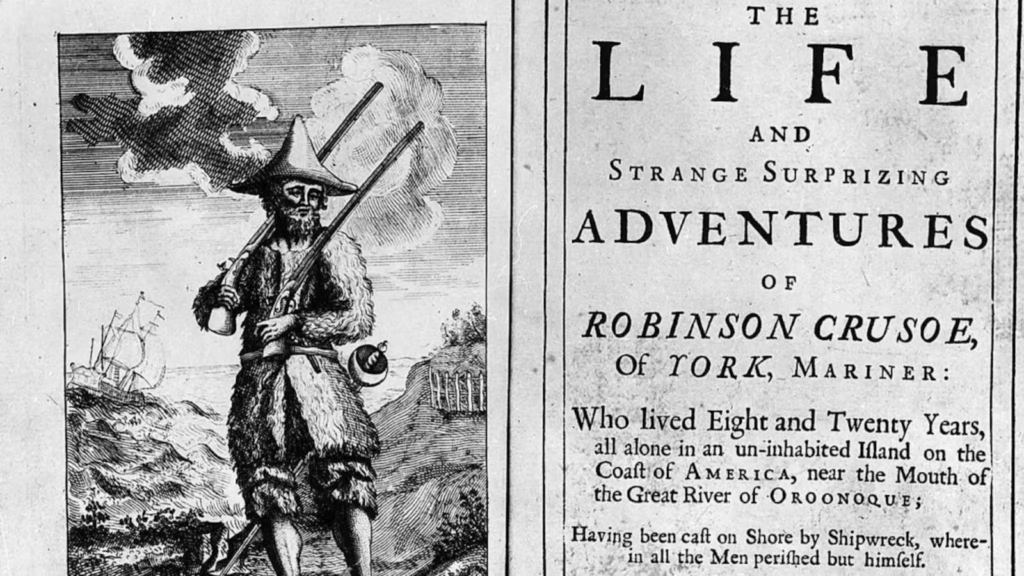
Daniel Defoe published his work in April 1719 under the long title The Life and Strange Surprizing Adventures of Robinson Crusoe, of York, Mariner: Who Lived Eight and Twenty Years Alone on an Uninhabited Island on the Coast of America, near the Mouth of the Great River of Oronoko; Having Been Cast on Shore by Shipwreck, Wherein All the Men Perished but Himself; With an Account of the Strange Story of His Deliverance by Pirates, Written by Himself. In later years it came to be referred to, in shortened form, as The Life and Strange Surprizing Adventures of Robinson Crusoe, of York, Mariner; yet in our own time—since it has acquired the status of the first novel of what is called Western literature (that is, of world literature, and more specifically of its English beginning)—it has been presented under the almost neutralized name Robinson Crusoe. To undertake a critical reading of a novel that has been dissected in every respect will not be easy. Beginning with questioning how the successive choices of title have passed through a process of canonization; how certain elements of the novel have been pushed into the background while others have been brought to the fore; how it has reached the present day as if passed through a sieve—like the “quite useful” sieve Robinson fashioned (p. 143), since none was among the tools he salvaged from the ship, in order to separate the flour of wheat from the bran when making bread—being sifted and diluted along the way; how it has today been reduced to such elements as the island, solitude, individualism, survival under harsh conditions, and the economic individual; how it has been turned into everyone’s novel, a novel that tells the story of everyone, thereby confronting any critical reading of Robinson Crusoe today with a vast cluster of problems—this much is beyond dispute. Indeed, how could the adventures of a mariner from York—whose father was not even originally from there—have become everyone’s story? Especially when, as the novel’s original title makes clear, in the shipwreck “everyone” dies and only one man, Robinson Crusoe himself, survives?
Akşit Göktürk, the Turkish translator of Robinson Crusoe, offers an explanation for this in the preface he wrote for his translation: Robinson Crusoe is “the epic of the ordinary person—of ‘everyone’—who, in the Age of Enlightenment, stands before the universe, striving to break with traditional rigidities and to transform the world through the power of reason” (p. 14). Ian Watt, too, in The Rise of the Novel, his study of Defoe, Richardson, and Fielding, endorses Göktürk’s notion of this “everyone,” albeit in a further diluted form, and defines the novel as the novel of “Crusoe (and indeed of all of us)” (p. 137); yet his “everyone” is the “economic individual.” Katherine Clark, who has also written one of the most interesting biographies of Defoe, in her work Daniel Defoe: The Whole Frame of Nature, Time and Providence, offers yet another “everyone,” writing it with a capital letter as if to draw the claim that Crusoe is “everyone” in bolder strokes: “By imposing his will upon the natural world and learning to submit to the all-encompassing will of God within it, Crusoe becomes Everyone” (p. 113).
Three elements stand out in these definitions of “everyone”: the Age of Enlightenment, the economic individual, and a Puritan character who imposes his own will upon nature while submitting to the will of God. Therefore, approaching Robinson Crusoe as a novel within the framework of universality, island consciousness, and the nature of the personality that produces this consciousness—and evaluating these particularly in relation to their counterparts in philosophical traditions in order to show how the novel has been subject to different interpretations over time—is of particular importance for any attempt to approach Robinson Crusoe. This method will, on the one hand, make it easier for us to confront the problems generated by the vast body of scholarship on the novel, and on the other, enable us to demonstrate how the novel has been passed through a sieve, abstracted and universalized, and—so to speak—how a figure who in fact has a place and a homeland has been presented as if rootless and placeless and thereby claimed for “everyone.”
Of the three elements, placing Robinson Crusoe within a “robinsonian” (robinsonade) framework in relation to the Age of Enlightenment, and thereby abstracting it, is a frequently employed method. The most famous example of this comes from Jean-Jacques Rousseau. For Rousseau, Robinson Crusoe—stripped of its excess burdens (that is, of all the narratives outside the island)—serves as a reference book both for his own autobiography and for the pedagogy of Émile, in which he recounts the stages of the educational life, from infancy to adulthood, of a child whose tutorship he undertook in order to demonstrate how education ought to be. However, for Rousseau the novel begins on the island and ends on the island; indeed, the adjective “robinsonian” derives precisely from this: a hermit condemned to live alone on an island. Rousseau’s Reveries of the Solitary Walker is devoted to such “robinsonian” wanderings and signifies, for Rousseau, an autobiographical Robinsonhood. Moreover, his taking refuge on a small island in a lake near Geneva—after he was forced to flee when his house in Neuchâtel was stoned—is presented as both the happiest and at the same time a “sweetly sorrowful” period of his life, not merely as an imaginary but as an actual Robinsonhood (pp. 80–94). Rousseau’s autobiographical Robinsonhood emerges in bolder lines in another work, Judge of Jean-Jacques: Dialogues, in which he judges himself in the form of a Socratic dialogue and where, in fictional terms, a “Frenchman” poses the questions and Rousseau provides the answers. There Rousseau says of himself: “In him I perceived a unique and almost unbelievable condition: in the middle of Paris, a solitude greater than that of Robinson on his island.” Rousseau identifies with Robinson Crusoe to such a degree that it might even be said that he “knowingly assisted those who persecuted him [that is, those who conspired the ‘universal plot’ against him] in making him more isolated.” While others “worked ceaselessly to keep him apart from other people, he too withdrew ever further from others and from them” (pp. 128–129). In this respect Rousseau is a double Robinson: both a voluntary and an involuntary Robinson.
However, the attitudes generally adopted toward him in the circles in which he lived, the intrigues carried out behind his back—what he called the “universal conspiracy,” and which has sometimes been explained, for example, through Voltaire’s attitude toward him—also compel him toward a robinsonian condition. According to Rousseau, “whatever the motive that provoked the formation of the conspiracy, a conspiracy there is” (p. 81); yet in Reveries of the Solitary Walker he attributes this to an interesting cause, a celestial will. That is to say, the reason for his robinsonian condition is celestial: “The convergence of so many unexpected circumstances in order to form a common conspiracy, the rise of my most ruthless enemies—so to speak by a twist of fate—the inclusion, as if specially selected, of all the rulers of the state, all those who shape public opinion, all persons of authority and influence, all those who secretly bear me ill will, in this common conspiracy—this universal accord was far too extraordinary to be mere chance. A single person opposing the conspiracy, a single event standing against it, a single unforeseen obstacle would have been sufficient for its failure. But all individual wills, all necessities, fortune itself, and all profound changes strengthened the efforts of men; and the incredible convergence of circumstances left me no doubt that the complete success of their designs was the eternal will of Heaven.”
This means that the “universal conspiracy” that persecutes Rousseau is at the same time the command of a “celestial and eternal will,” and Rousseau, precisely because it is so, assists it himself, surrendering with his own hands to that will. In this sense the distance between Rousseau and Crusoe is not very great; for Crusoe too, even if he does not call it a conspiracy, explains what happens to him as something ordained for him by Heaven, and thus almost meets Rousseau—who experienced changes of faith, first Calvinist, then Catholic, and then Calvinist again—at the same point. [Here it may be useful to open a parenthesis and refer to a remark by Paul de Man in Blindness and Insight: de Man argues that what Romanticism places opposite the subject and calls “nature” is in fact “Providence” in Protestantism, or at least that the prehistory of Romanticism cannot be thought without thinking “Providence”; he situates Rousseau within this framework and, moreover, in the relationship between Robinson and Rousseau, he places Daniel Defoe not in the camp of modern realism but in that of “the Puritan religious element to which Rousseau was responding” (pp. 216–259).]
However, the most striking aspect of Rousseau’s Crusoe is that, apart from the autobiographical Crusoe, he also constructs a pedagogical Crusoe. In Émile, or On Education, Rousseau begins by saying, “I do not like books; they speak only of things we do not know.” Yet, since a child’s education cannot be without books, he searches for a single book that could bring together all the others and states that he has found it: “Since we must have books, there is one which, in my opinion, is the supreme book of natural education. This will be the first book my Émile will read, and for a long time it alone will constitute his entire library.” What is this rare, “extraordinary” book? “Is it a book by Aristotle? By Pliny? By Buffon?” The answer is none of these; it is Robinson Crusoe. For “the surest way to overcome one’s prejudices and to arrange one’s thoughts according to the true relations of things is to put oneself in the place of an isolated man and to evaluate everything exactly as this man would evaluate it, taking his own benefit into consideration” (pp. 204–210). This means that the surest way for “everyone” to free themselves from their prejudices and to order things according to their real relations is for “everyone” to place themselves in the position of the “isolated man” and to evaluate “everything” as Robinson would evaluate it, considering it in terms of his own benefit. At this point we move away from the novel and approach Kant.
Whether Kant actually read the novel would require separate investigation; nevertheless, we know at least that he was aware of it from the references he makes to it in The Critique of the Power of Judgment. Although these references appear in different contexts, they can still be considered interconnected. According to Kant, the desire to escape society, the desire to remain alone, and the desire to live self-sufficiently on an island or on a farm “is regarded as something sublime if it rests on ideas that disregard all sensory interest.” The essential condition here is not to flee society, but rather to be able to rise above the need for society: “To be self-sufficient, therefore not to need society, and yet to be so without being unsociable, … without fleeing society—this is something that approaches the sublime.” Comparing this form of escaping society without fleeing it, which befits the sublime, with misanthropy and anthropophobia, Kant considers the desire to withdraw from society that arises from these motives to be “something repulsive and, to some extent, contemptible.”
However, there is also a condition mistakenly called misanthropic, which constitutes an exception: “There is undoubtedly a misanthropy (very improperly so called) toward which many well-thinking people frequently show an inclination as they grow older; although it is certainly sufficiently philanthropic as far as benevolence is concerned, through long and painful experience it has moved far away from delight in human beings. The evidence of this lies in a tendency toward seclusion, a dreamlike wish for some distant rural retreat, or (in the case of the young) the fantasy of happiness spent on an island unknown to the rest of the world with a small family—a dream that novelists or writers of Robinson stories [Robinsonaden] know very well how to exploit” (p. 139). This means that the desire for social withdrawal without seeking any advantage from it, without expecting any benefit from it, in a philanthropic spirit—such as the desire for an imaginary adventure of withdrawing from society for one reason or another while remaining philanthropic, as told in robinsonian narratives—is different from the desire to flee society out of hatred of humanity or fear of human beings. One of these is sublime, whereas the other is repulsive.
However, what constitutes the difference between these two? Unlike the first two Critiques, which posit the transcendental conditions of knowing and willing a priori, the feeling of the beautiful discussed in the third Critique—where the conditions of the faculty of judgment must necessarily be derived from the empirical—and the concept to be obtained from it can be reached “only in society.” Yet since a priori knowledge cannot be social, but concerns human beings only insofar as they are rational beings, how will a transcendental construction of the social use of the faculty of judgment be possible? Clearly through what Peter Szendy—marvellously naming it in his Kant in the Land of Extraterrestrials—calls the “cosmetic motive” (p. 61). Kant says in the Critique of the Power of Judgment: “A man abandoned alone on a deserted island would adorn neither his hut nor himself, nor would he seek flowers or cultivate them in order to decorate himself with them; rather, it would occur to him only in society to be not merely a human being but a refined human being according to his kind (the beginning of civilization); for we judge someone to be such who is both inclined and able to communicate his pleasure to others, and who cannot be satisfied with an object if he cannot share the liking for it with others” (p. 164).
The metaphor of the deserted island here does not very strongly evoke Robinson Crusoe. For we know that Robinson, while on the island, made various “cosmetic” arrangements beyond meeting his basic needs: he decorated the environment in which he lived and even created for himself a kind of summer residence. Nevertheless, the adjective “deserted,” used mostly to qualify an island but sometimes also a desert, appears several times in the Critique of the Power of Judgment. For instance, the example of the “deserted island,” which Kant employs in order to object to the claim that tastes cannot be disputed and to show that the beautiful, even in its subjectivity, carries a dimension capable of forming a general judgment on behalf of humanity—a judgment arising from the empirical yet not itself empirical—works in this direction (while also noting the strangeness of the example of an Indian chief in Paris): “If someone asks me whether I find the palace before me beautiful, I might say that I do not care for things made merely to be gaped at; or I might answer like that Indian chief who in Paris liked nothing so much as the taverns; or, in Rousseau’s manner, I might reproach the vanity of the great who squander the sweat of the people on such unnecessary things; finally, I might easily persuade myself that if I found myself once again on a deserted island, without hope of ever returning among human beings, and if by mere wishing I could bring such a splendid structure into existence, I would not trouble myself with it at all, provided I already had a sufficiently comfortable hut” (p. 55).
The deserted island here too is “cosmetic.” If others exist, if I am within society, then my conception of beauty has a value. A human being left entirely on his own, even if he counts among rational beings, is deprived of the gaze of others and may therefore be likened to a hut—or to an Indian chief brought to one of the most important centers of civilization who, instead of admiring the beauties around him, prefers a kebab shop.
But how can such a point of view be attained? How can one, while living in society, behave as if one were not living in society—as if one were living on a deserted island or in a desert—and thereby reach that sublime of the faculty of judgment? While Kant indicates that what is “sublime” points to behaving as though one had withdrawn from society while still existing within it, he adds something further: “To be self-sufficient, therefore not to need society and yet to be so without being unsociable, … without fleeing society—this is something that approaches the sublime; just as it is to look down upon one’s needs.” Yet how far one must look down from above is difficult to determine in Kant’s case; behind this difficulty lies not only the question of whether one may attain the felicity of reaching the vastness of the “cosmopolitan” point of view he proposes while considering “universal history” with a “cosmopolitan aim.” In fact, from this perspective Kant’s universe opens so widely toward the cosmos that, in Anthropology from a Pragmatic Point of View, when he approaches “anthropology” from a “pragmatic point of view,” he notes that classifying the human being as a species would be impossible without another rational species comparable to it; in that case the middle term of comparison would be lacking, and thus he opens the problem onto the cosmos itself: “If we compare a species of being known to us (A) with another species of being unknown to us (non-A), how can we hope or demand to indicate a character of the former when the middle term of comparison (tertium comparationis) is lacking for us?—The highest concept of species may be that of the terrestrial rational being; yet we shall not be able to name its character, because we possess no knowledge of non-terrestrial rational beings that would make it possible to display the characteristic property of the terrestrial.—Thus it appears that the problem of indicating the character of the human species is absolutely insoluble; for the solution would have to be found through the experience of comparing two species of rational beings, but experience does not present this to us” (p. 225).
Where, then, can the limit of Kant’s own critique be drawn? For example, by inviting into thought—at least through the power of association—rational beings that are not terrestrial or earthly, say extraterrestrial or alien ones? Or by attaining a cosmopolitan, cosmetic, or pragmatic point of view through living in society as though one were not living in it—looking down upon one’s needs and living like a hermit, or in a robinsonian manner? Kant probably knew Robinson Crusoe through Rousseau, and for him too the novel began on the island and ended on the island.
Yet there is a passage in the novel that comes close to Kant’s “sublime.” In the second of the essays titled “Daniel Defoe,” included in the collection Essays, Articles, Reviews, James Joyce compares a passage from the novel Robinson Crusoe—which he describes as the true symbol of the British conquest of the world: “European criticism, for several generations, tried with not altogether benevolent persistence to illuminate the secret of the immense conquest of the world achieved by that hybrid race which, living a hard life on a small island in the northern sea, had been granted neither Latin intelligence, nor Jewish patience, nor German zeal, nor Slav sensibility … [Yet] the real symbol of the British conquest is Robinson Crusoe, who on the deserted island where he has fallen with a knife and a pipe in his pocket becomes architect, carpenter, grinder, astronomer, baker, shipbuilder, potter, saddler, tailor, umbrella-maker, and priest”—with the vision in which Saint John, on the island of Patmos, witnesses the apocalyptic destruction of the universe and then the shining rise of the walls of the eternal city, the Kingdom of God. Yet this passage concerning the “bare footprint in the sand,” which Crusoe sees as “the single miracle he beheld in all creation,” recalls Kant in two ways.
First, after so many years spent on the island, the moment Robinson sees “the footprint of a naked human foot,” a single footprint whose cause he does not know, which suddenly appears before him and for which, despite searching, he cannot find another like it, he behaves as if he has encountered something truly “sublime.” He is so frightened, so anxious before this causeless trace that not only his capacity for sound judgment but even his entire existence on the island is shaken. While moving among various thoughts—from seeing the footprint as a trick of his imagination to interpreting it as a sign of the Devil, even as the trace of “some other being in human shape” (p. 176)—he releases the animals he has domesticated, disrupts the order he has established on the island, and takes measures to double his security. The footprint, which lifts him from the ground as though it were the sublime itself, increases what Tony C. Brown, in The Primitive, the Aesthetic, and the Savage: An Enlightenment Problematic, calls Robinson’s “anthropological insecurity,” leading him constantly to believe that the “destruction” he often expects because of his “original sin” has finally arrived (p. 186). So much so that whereas previously his chief sorrow had been “to be condemned to a silent life, far removed from human society, entirely alone, surrounded by endless seas, as someone whom God did not deem worthy to join among His living servants or other creatures,” and whereas seeing “one of his fellow human beings” would have seemed to him “like rising from the dead,” he now trembles with fear at the mere possibility of “seeing a human being” (p. 178).
Yet he begins to overcome this fear of seeing another human being by accepting something that will ultimately lead him back among human beings. In the end he comforts himself with the thought that the footprint may have been left by savages who occasionally come to a part of the island he rarely visits in order to hold cannibal feasts, and thus he regains his “anthropological security.” Indeed, even the savages from whose hands he will accidentally rescue Friday—although he is disgusted by their feasts of human flesh—he comes to judge differently: he concludes that he has neither the “right nor the authority” to regard these men, whom “God has for ages tolerated without punishing and has allowed to execute His judgments upon one another,” as criminals and to punish them by killing them (pp. 192–193). Robinson, a terrestrial creature, escapes the anxiety caused by a single footprint—which drives him toward an extraterrestrial fear (and, of course, toward the sublime)—not like the “ordinary person who, in the Age of Enlightenment, stands before the universe, striving to break traditional rigidities and transform the world through the power of reason,” but by adopting a view that hierarchically divides humanity in order to secure his anthropological safety.
But did he truly do this as a terrestrial—or earthly—creature, even while he was on a deserted island?
Robinson Crusoe an “Island” Novel?
“Man is a terrestrial being,” says Carl Schmitt in his work Land and Sea; he is “one who sets foot on land.” While stating that man (German, Landwesen; corresponding to the English “terrestrial”) is a “land-being,” a being that walks on land (Landtreter), Schmitt also points out a distinction: “This is where he stands and the ground beneath him; he secures his perspective through this, and it determines his impressions and the way he observes the world. It is not merely his horizon, but also the form of his walk and movements, and even his body itself that he acquires as a living being born on and moving across the earth.”
This is a perspective that accomplishes two things at once. First, it perceives the planet it inhabits in relation to its terrestrial existence: “As a consequence, it designates the celestial body it inhabits as ‘Earth’ [Arz].” Second, this planet is not entirely composed of land or soil; three-quarters of it is water, while only one-quarter is land, that is, dry land—so much so that even the “largest landmasses on this planet float like islands.” Nevertheless, although the planet he inhabits is spherical, and although he refers to it as a “terrestrial globe” (Erdball) or “earthly sphere” (Erdkugel), he does not, based on the volume occupied by water, call it a “marine globe” (Seeball) or a “sea sphere” (Seekugel) (p. 52).
Thus, according to Schmitt, the human horizon is ultimately bound to the Earth.
However, this does not mean that humanity has always been defined in this way. In his 1963 book Partisan, published as a kind of appendix to his 1932 work The Concept of the Political, Carl Schmitt notes that space, like the sea, is open to the appropriation of “everyone,” yet ultimately to whoever claims sovereignty over the Earth; he implies that a “spatial revolution,” similar to the one that occurred in the transition to a maritime conception of sovereignty, could also take place, and that “astronauts” and “cosmonauts” in space might have the chance to transform into “cosmo-pirates or even cosmo-partisans” (p. 109).
Therefore, if it is to occur at all, humanity’s appropriation of outer space will unfold much like its appropriation of the sea. In that case, how can it be said that we are terrestrial beings? According to Schmitt, at least insofar as the horizon is drawn on land, humanity is a terrestrial entity. However, as if to object to interpretations that identify Robinson with “everyone” in The Concept of the Political, he adds an intriguing point by equating “everyone” with “humanity”: “Humanity cannot wage a war, because it has no enemy, at least on this planet” (p. 84). Perhaps, if there are other beings in space, humanity—as a being that walks on Earth—could wage a war in the name of humanity; yet on this planet, this is not possible. Schmitt’s explanation on this matter is also persuasive: “The concept of humanity itself excludes the concept of the enemy, because the enemy continues to be human on the other side, and therefore there is no specific difference between the two concepts… When a state wages war against its enemy in the name of humanity, this is not a war of humanity, but rather a war in which a state seeks to fully appropriate a universal concept against the enemy it is fighting.”
This means that Robinson’s being described as “everyone” does not indicate a universal validity; rather, it shows that he appropriates universality in the name of “everyone” as “an ideological apparatus highly suited to imperial expansionist activities and, with its moral-humanitarian character, to the use of economic imperialism” (p. 85). At least on this planet—and certainly on a deserted island where the anxiety produced by a footprint (or, to put it in Joyce’s terms, a miraculous sign) can only be alleviated by acknowledging the existence of savages.
Then, could Robinson be a “pirate” who, like the “cosmo-pirate” or “cosmo-partisan” that Carl Schmitt claims might emerge in the race for the appropriation of space, also lays claim—under this very title—to a universality encompassing “everyone”? Is the possibility of Robinson as a pirate feasible?
Although Robinson Crusoe is a novel that reflects island consciousness and views the world from the island, since it is not strictly an island novel, Robinson’s adventures outside the island—apart from the note that he abandoned his “middle-class” life by disobeying his father’s advice in pursuit of adventure—are generally not taken into account in analyses of the novel.
Yet the novel has certain specific junctures both before and after the island which, if overlooked, can lead not only to a misinterpretation of the novel but also to its dilution, as if it had been passed through a sieve. One such moment emerges after Robinson, having disobeyed his father’s advice, first began to make money through voyages from Hull to London and then from London to Guinea; after, during a second voyage to Guinea, his ship was captured by “Turkish pirates,” and—unlike the other sailors—the captain of the ship chose to keep him in his own house rather than sell him in the market, as a result of which he remained a slave in the Maghreb for about two years; after escaping from this slavery with a young Muslim Maghrebian named Ksuri, and while fleeing, instead of steering toward the free world—Europe—he turned toward the African coasts and wandered for some time in the hope of encountering a European ship; after the small boat in which they fled drifted along the African shores for a while and they were rescued by a Portuguese ship; after he sold to the captain of this ship bound for Brazil both the hides of the animals they had captured along the African coasts and Ksuri himself—on the condition that he would be freed after converting to Christianity ten years later; after arriving in Brazil, completing the procedures of naturalization and obtaining a residence permit; after purchasing land with the money he had earned to establish a plantation, and devising ways to bring to Brazil a portion of the money he had entrusted to a widow in London during his first Guinea voyage in order to develop this plantation; and finally, after the need for slaves to work on this plantation arose and they began to consider solutions to this problem together with neighboring plantations.
[At this point, two notes in parentheses: In Defoe and Spiritual Autobiography, G. A. Starr argues that Robinson and Ksuri consciously chose this escape route—not toward Europe but toward the open sea—and that, rather than moving toward places where a settled civilization existed, they withdrew (in the Schmittian sense) into an “empty space,” toward a place that would further worsen his “spiritual condition,” and toward a place where God’s all-encompassing will would lead him to salvation and render him chosen (p. 88). Second, unfortunately, Göktürk has translated all instances of the word “plantation” in Robinson Crusoe as “farm.” Thus, both the historical meaning and the colonial connotation of the term “plantation” have been lost.]
In fact, on this colonial plantation in Brazil, Crusoe seems to have fallen onto a “deserted island” even before he is cast onto the “deserted island.” In this region where plantations are located, he has no one to speak to except for “a Portuguese neighbor named Well, born to English parents.” He does every task on the plantation with his own hands (just as he will when he is cast away on his deserted island).
Moreover, in this plantation life in Brazil, he feels as though he has fallen into the “middle-class” life his father had advised him not to abandon. It is like a “deserted island” to him, to such an extent that he is “a thousand miles away from his home, in a wilderness among strangers and savages, unable to send word to any corner of the world about what he is doing” or “even what he is.”
Nevertheless, when the money he had entrusted to a widow in London reaches him, he hires “a black slave and a European servant” for himself. And he remains in Brazil for four years. He also earns a good income from his plantation (pp. 53–57).
There is, however, one problem. The environment is overwhelmingly Catholic. Although he does not regard them as “neighbors” in terms of his faith, Crusoe—who claims that he has no one to speak to—learns the languages of these Papists and establishes acquaintances both with his “colonial [planter] friends” and with the merchants at the port. In fact, he is instilling in them the ideology of the island: “During my conversations with them, I mostly spoke of my two voyages to the Guinea coast, of how trade was conducted there with the blacks—using trifles such as beads, toys, knives, scissors, hand axes, and pieces of glass—and how, not only gold dust, ivory, and Guinea spices, but even slaves to be employed in Brazil could be acquired.”
The problem, however, lies here: “They listened very attentively to what I said, especially to my remarks about purchasing black slaves. At that time, the trade in black slaves had not yet fully taken off; however, since it could only be conducted with the assiento or special permission of the King of Portugal and the King of Spain, very few blacks could be brought in, and those were sold at very high prices” (p. 57).
What is assiento? The Turkish translator of the book, Göktürk, provides no note regarding the term. However, there is a note on the term by Thomas Keymer and James Kelly, who edited the Oxford World Classics edition of Robinson Crusoe: “Since Spain had no foothold on the slave coast, contracts were granted to foreign nations, companies, and individuals to supply African slaves to their colonies [dominions] in the New World. After Portugal’s asiento de negros came to an end, the slave trade to Spanish America became almost entirely illicit until 1702, when the monopoly was granted to the French Guinea Company. Crusoe is mistaken in asserting that a contract was mandatory in 1659; however, from 1662 onward, a formal asiento was briefly held by Genoese merchants. After the Treaty of Utrecht (1713), the asiento was transferred to the British South Sea Company; however, following various wartime suspensions—the first in 1718—it was abolished in 1750” (pp. 262–263).
In fact, this note is not very explanatory either; however, Carl Schmitt, in Land and Sea, provides a framework through which we can understand the matter: As soon as America was discovered—although Columbus had arrived there without knowing it was a new continent—in 1493, the Spaniards obtained a papal bull from Pope Alexander IV stating that the newly discovered West Indies were granted, on the basis of apostolic [papal] authority, as a temporal fief of the Church to the King of Castile and León and his heirs. In the bull, a line was drawn in the Atlantic Ocean running approximately one hundred miles west of the Azores and Cape Verde. All discoveries to the west of this line were granted to Spain by the Pope as a fief. The following year, through the Treaty of Tordesillas, Spain reached an agreement with Portugal that all lands discovered to the east of this line would belong to Portugal (p. 118).
The lands divided as “fiefs” by a papal bull were, in a rather peculiar manner, conceived as empty spaces. For a long period, Spain and Portugal regarded the lands beyond the ocean as their own property on the basis of the bull obtained from the Pope and sought to keep all forms of trade in these lands (including slavery) under their control. Then, the Protestant peoples—who did not accept the papal bull, and indeed did not accept the Papacy itself—entered into a struggle of appropriation with the Spaniards and the Portuguese.
“Through the Reformation, the Protestant peoples explicitly rejected every form of authority of the Roman Papacy. Thus, the struggle to seize the lands of the New World turned into a conflict between the Reformation and the Counter-Reformation, and between the Spaniards representing global Catholicism and the Huguenots [French Protestants], the Dutch, and the English representing global Protestantism” (p. 119).
The struggle (including the slave trade) was won by English Protestantism, which emerged with the principle that “all trade is free trade.” The Treaty of Utrecht was the triumph of those who had transformed from “shepherds” into “sons of the sea”; it signified the validation of the English understanding and dominance that advocated conducting all forms of land and sea trade “freely,” without seeking permission from any authority other than the British king. In short, Robinson advises the colonists around him to pursue this “free trade”—a form of trade which, in his time, could only be carried out through piracy.
He will indeed reap the rewards of his advice. For one day, when he passionately declared before a “community” composed of colonial plantation owners and merchants that they could once again bring slaves from Guinea, he was visited the next morning by three men who stated that they were in need of slaves. They had come with a “secret offer,” on the condition that he tell no one: they were planning to prepare a ship and send it to Guinea; their aim was to “bring a black person secretly in a single voyage to Guinea”; since they could not “sell them openly,” they planned to “distribute them among their own plantations”; would Crusoe become the “cargo officer” of the ship for this secret voyage to Guinea, intended to bring slaves secretly and distribute them secretly? (pp. 57–58)
This, then, is the most Schmittian moment of the novel Robinson Crusoe. In an environment where all commercial permissions are held by the kings of Spain and Portugal through a decree issued by the Papacy, and which is manifestly Catholic—thereby causing him to feel as though he has fallen onto a “deserted island” even before actually reaching one— Crusoe is confronted with an offer to set sail once again as the “cargo officer” on a secretly organized expedition intended to bring slaves to plantation owners who appear to have been persuaded through the spread of island consciousness.
Of course, he accepts the offer; and of course, the ship on which he is wrecked and ends up on the “deserted island” is precisely the ship on which he had set out for this pirate-like venture. Thus, the pirate Crusoe is cast from one ‘deserted island’ onto another.
Therefore, there is not much distance between engaging in pirate slave trade and, in the wake of a footprint, accepting the existence of savages. Nor is there much distance between the ordinary individual—said to have opposed nature and tradition during the Enlightenment—and the economic individual who, in pursuit of his own interests, seeks to impose order first on his island, then on the Earth, which is transformed into the open sea and subjected to appropriation, and even on outer space.
Moreover, there is a similar gap between the self-confidence underlying all those Enlightenment-era aspirations of deserted islands, Robinson-like existence, and living as though outside society even while within it, and anthropological insecurity.
But how, then, will this piracy justify itself?
Is Robinson Crusoe a Novel of the “Individual”?
Edward Said, in Culture and Imperialism, notes that Robinson Crusoe tells the story of “a European who creates a home for himself on a distant island outside Europe.” He interprets the emergence, or “rise,” of the novel in England within this context: “In England, the novel begins with Robinson Crusoe, whose protagonist establishes a new world under his own rule while asserting a claim to rights in the name of Christianity and England” (pp. 12 and 110). Nevertheless, as a genre, the novel will lead to the erasure—almost as if it had been sifted through a sieve—of the very part in which the hero “asserts a claim to rights in the name of Christianity and England.” This erasure begins with the claim that, with Robinson Crusoe, a “realistic” narrative form gradually comes to dominate.
One of those who exhibits the most extreme example of this erasure, Akşit Göktürk, in his encyclopedically valuable book Ada, in which he recounts the trajectory of the “island” in English literature, although he counts sea and adventure narratives among the sources of Robinson Crusoe, and although he states that “Robinson Crusoe bears traces of the Puritan worldview of Defoe’s time, of middle-class life, of trade—the principal occupation of this class—and of social and political currents. Defoe is a man of the middle class which, in the seventeenth and eighteenth centuries, established itself through revolutions both in England and in other European countries, gained a voice in social life, implemented its own system of values in every field, and exerted weight upon the governance of nations,”—thus in fact assigning an identity to “everyone”—cannot refrain from casting him into the mould of a ‘total Western man’ as perceived in the Republican era: “Especially in interpretations made from an economic perspective, Defoe’s creativity and artistic personality have always been overlooked. Robinson Crusoe has become an inseparable part of European literature and has been accepted as one of the myths underlying the European mind and civilisation, yet its meaning has been limited by being interpreted as ‘a myth that expresses the ideals of the successful bourgeois, the materialist Puritan businessman…’. It may indeed be true that Robinson Crusoe is a myth, but it is the myth of a human being who struggles to survive in a merciless universe, grapples with dead-end situations, and explores all the possibilities of his own strength” (pp. 87–88).Başka bir ifadeyle, Göktürk Robinson’un ekonomik birey olarak da, Avrupa uygarlığının içinden süzülüp gelmiş bir mitos olarak da sunulmasını kısmi bulur. Çünkü Robinson, “acımak bilmez bir evrende sağ kalmaya çalışan, çıkmaz durumlarla pençeleşen, kendi gücünün bütün olanaklarını araştıran insanın mitosu”dur ve bu anlamda evrenseldir.
What is more interesting, however, is Göktürk’s oscillation between the “Calvinist principle” and the universal “human.” Göktürk mentions, albeit as a possibility, that the novel may rest on a Calvinist tradition; that it may bear traces of the Puritan understanding of Defoe’s time, of the middle-class way of life that emerged from this understanding, of trade—the principal occupation of this way of life—and even of social and political currents. Yet he is troubled by the possibility that such interpretations—as well as those that evaluate the novel as the adventure of a blindly “individualist capitalist”—would reduce Robinson Crusoe to “a dry historical document in our time”; moreover, he is concerned that the “great interest” and “affection” it receives “in every kind of society today, regardless of its form of government” would become “meaningless.” However, Robinson’s endeavour is not directed solely toward the acquisition of goods; it is also directed toward “creating values.” Therefore, goods are vanity, property is vanity, and “Robinson is presented as a so-called ‘universal’ figure who, ‘through the illuminating power of labour, strives to realise and bring forth the human values lying dormant within him’; a universal figure who “does not content himself with goods and property, but finds happiness only in frenzied labour.” Robinson Crusoe is “a tribute to civilisation, to humankind that always seeks to advance further” (pp. 89–90). From this perspective, Göktürk’s Robinson is without a homeland.
Can Robinson— as a pirate, as a European who engages in colonial activities in the name of Christianity and England, as a “Robinsonian” figure, and most importantly as a Puritan—truly be without a homeland? Does a Robinson Crusoe who may be said to have somehow amalgamated all of these have no place, no home, no country, no homeland?
The image of Robinson drawn by Ian Watt in The Rise of the Novel rests on a rather simple proposition. Watt evaluates Robinson as “the embodiment of homo economicus”: “That Robinson Crusoe … is the incarnation of economic individualism is almost beyond dispute” (p. 71); admittedly, in The Myths of Modern Individualism he cannot express his proposition in such a clear and rigid manner and revises this point, which had seemed almost beyond dispute; here he accepts that Crusoe should not be “assumed to be an ideal-type homo economicus”; because the Watt of The Myths of Modern Individualism has noticed certain things that the Watt of The Rise of the Novel had previously failed to perceive, and has observed that on the island Crusoe does not merely work as a representative of homo economicus, but also invents small amusements, plays with his parrot, and even has cats (!). Thus, the new Robinson now “stands somewhere between homo economicus and the simple human” (p. 199). What, then, is Crusoe as homo economicus?
In fact, Watt’s image of Robinson is Weberian; although he occasionally refers to Locke or Marx, he takes as his model Weber’s “Protestant ethic,” which Weber claims began with a Puritan impulse but later became independent of it. Yet is there not, in these and similar interpretations, a perspective that regards Protestantism not as a “religion” that emerged as a reaction to Catholicism, nor as a “religion” possessing a political mentality that, while opposing a particular conception of sovereignty shaped under the determinative role of the Papacy, developed its own distinct understanding of sovereignty, but rather as an (economic) ethic and an (economic) culture—and that sees literature as a field which, within such a culture, has formed its own autonomous domain and carries its own stylistic concerns? Even if it does not fully encompass the issue presented as “economic individualism,” the importance of this question becomes evident when we consider Watt’s three theses: The first is that Robinson is so self-interested that even his “original sin” leads him to make money; the second is that, in the absence of economic virtues, he is xenophobic, whereas otherwise his praise of foreigners is “boundless”; and the third is that, although he has “religious concerns,” these “possess no particular priority.”
Watt associates the first point—which may almost be seen as connected to the third—with an impulse that compels Robinson to abandon not only his home but also his homeland; and, at other times as well, particularly when he is cast onto the “desert island,” with the “ungovernable passions” within him that surface as he questions himself, and with his “dissatisfaction with the position that God and nature deemed him worthy of.” According to him, Robinson’s “original sin” is not his failure to heed his father’s advice not to abandon the middle station of life and embark on adventures, nor his irresponsibility toward his family, nor his religious sentiments, but rather his calculation of whether “leaving or staying would be more advantageous in material terms.” From this perspective, Robinson “profits by his ‘original sin’ and becomes richer than his father” (p. 74). In short, according to Watt, “original sin” takes the form of abandoning one’s home and father’s house for the sake of gain. Yet this can only mean either that one has never read Robinson Crusoe at all, or, even if it has been read, that one suppresses the meaning of the text.
In fact, the theme of “sin” in Robinson Crusoe first begins to appear in the journal he starts writing after he is cast onto the island. Robinson has fallen onto the island, has encountered various hardships, and has undertaken certain efforts to overcome them. Nevertheless, since the religious knowledge he had acquired during his father’s upbringing had been erased during his time among sailors, he says that he has no “knowledge of the things of God.” Yet he does have a knowledge of the things of God: “If I were to say that I never once thought that all the painful events that befell me in the adventures I have recounted so far were a command of God, the consequence of a sin I committed, the punishment for rebelling against my father’s wishes, of my numerous present sins, or of the wrong path I have followed throughout my life, then this disrespect toward God would be easier to understand” (pp. 108–109). Indeed, this state of disrespect becomes so overwhelming that he asks God to deliver him from the heavy burden of the sins that have deprived him of all comfort and peace, and from this seemingly dreadful condition. Even his loneliness does not weigh more heavily upon him than his sins. In his solitude, by himself, he even makes confession, and by declaring the anniversary of the day he was cast onto the island a religious day, he keeps a fast: “I counted this day as a feast day distinct from other religious days; with all my heart I humbled myself and prostrated before God, openly listing and pouring out my sins, accepting the righteousness of His judgments concerning me, and begging Him to forgive me through the exalted Jesus. I put nothing in my mouth for twelve hours until sunset; then I ate a biscuit and a bunch of grapes, and, ending my day as I had begun it, I went to bed” (p. 123). He begins to read the Holy Scriptures three times a day and to practise ‘tefeül’ (bibliomancy), making prophecies (p. 134). [A parenthetical note: Akşit Göktürk’s translation choices here and in similar passages are, in a manner consistent with his calling Robinson the myth of humanity, almost neutral. For instance, he translates Robinson’s fasting (“I kept this Day as a Solemn Fast”) as “feast day.” He renders all Sabbaths as “Sunday,” producing such unclear sentences as: “Throughout this entire period, I had not distinguished Sundays from other days; for at first there was no thought relating to religion in my mind” (p. 123). Here, the Turkish reader cannot grasp the religious significance of Sunday. Yet Sunday has been the Sabbath for Robinson since the day he was cast onto the island; however, until now, he had done nothing for the Sabbath and had worked even though he was not supposed to. Now, by fasting as an act of repentance, he also observes the Sabbath.]
On the anniversary of the fourth year since he was cast onto the island, he now looks at the world as if from the “other world” and states that he no longer has any desire for it: “I now look upon the world as something distant from me, from which I expect nothing, with which I have no further dealings; I harboured no desire regarding worldly affairs. In short, I had nothing left to do with it, nor did I desire anything from it; to me, in this state, the world seemed like a place I once lived in but have now left—perhaps as it would appear when viewed from the other world.” He now regards the world exactly as it is written in the First Epistle of John 2:16: “At first, I was far removed from all the baseness of the world. I felt no desire of the flesh, nor of the eyes; nor was there any cause for pride in my way of life” (p. 149). Yet, unless we attempt to understand the text through Protestant references, he speaks of something else that may seem strange to us: “There was nothing I could desire; for in my present condition I had everything that could satisfy me. I possessed a vast domain; if I wished, I could call myself the king or the emperor of all the lands I owned. There was no one who would dare to rival me; neither an adversary nor anyone who would interfere with my sovereignty or meddle with my commands. If I had wanted to, I could have produced shiploads of goods; but since I had no use for them, I produced only as much as was sufficient for myself” (pp. 149–159).
Thus, despite being a sinner, he begins to feel that he has been “chosen” by God, that God has treated him generously, and that He has forgiven his wrongdoings. Noting that the day he was born and the day he was cast onto the island fall on the same date (30 September), he states that his life of “solitude,” in which he began to repent of his sinful life, also began on that very same day (p. 154). He then turns to the matter of “original sin.” Although such repetitions may not pose much difficulty for the readers of his own time, given their effect as a kind of “sermon,” they appear rather excessive to the modern reader. In yet another of these repetitions, Robinson, once again reviewing his life, says—according to Akşit Göktürk’s translation: “With all these circumstances, I may be regarded as an example from which a lesson should be drawn for those afflicted with a condition that is the source of half of humanity’s sufferings; by the word ‘plague,’ I mean to indicate a refusal to be content with the condition that God and Nature have deemed appropriate for man; for my failure to look back and my disregard of my original condition, my refusal to heed my father’s wise counsel, my acting against those counsels—these constituted my original sin; and when other similar sins followed, I fell into this miserable state; for Almighty God had settled me in Brazil as a happy colonial planter and had granted me my desires; had I been content to proceed gradually, today—indeed, during the time I spent on the island—I would have become one of the leading planters of Brazil; considering the progress I made while living there and the gains I might have achieved had I remained, I could, at that rate, have amassed a fortune of a hundred thousand gold pieces. What business had I to leave a settled, well-established, thriving slave-based plantation and go to Guinea as the ship’s cargo officer to bring back slaves? In time, with patience, our earnings would have increased right where we were; we could have purchased the slaves we desired from those engaged in that trade at our very doorstep; perhaps this would have cost a little more; but the profit I would have gained by the other route was not worth undertaking so much danger” (pp. 216–217).
First of all, it must be noted that among the words we have underlined here, the word rendered as “disease” is not “disease” but “plague,” and that for Robinson this is a word carrying far deeper and more spiritual connotations than an ordinary ailment such as a sore throat; that the word translated as “farmer” does not refer to a simple cultivator working his fields and vineyards, but to a colonial “Planter” who establishes plantations; that the word rendered as “farm” likewise corresponds to “Plantation,” a colonial enterprise dependent on slave labour; and that the word rendered (in a racially distorted manner) as “Arab” in fact corresponds to “Negro.” However, when considered together with the word “Arab,” the choice of the expression “original sin” also reflects the nature of the humanist culture (and translation practice) that is being promoted in Turkey. This word is “ORIGINAL SIN”—“ASLİ GÜNAH”—one of the foundational doctrines of Christianity, whose importance is further underscored by its capitalization in the English edition of Robinson Crusoe. Here, Robinson Crusoe expresses that, alongside other things, through reflecting on his “sins” and on “original sin” on the island, he is “reborn”; and this meaning is perfectly clear both to readers of Defoe’s time and to modern readers. Naturally, this is also clear to Göktürk and Watt—who detach it from its context and behave as though “everyone” were reading entirely different texts.
Yet Watt is not alone in this kind of interpretation. Indeed, it is worth recalling that Thomas Keymer and James Kelly, who also append a note to the term in the Oxford World’s Classics edition, offer an explanation that not only removes the doctrinal context of the word but also universalises the meaning it signifies, making it apply to “everyone”: “ORIGINAL SIN: literally, a state of corruption and sinfulness innate in all human beings as a consequence of being expelled from Paradise, but a term frequently applied by Defoe to specific individual faults” (p. 295).
From this perspective, the principal problem in Watt’s reduction of the “original sin” in Robinson Crusoe to economic individualism is that, despite—or together with—Robinson’s “original sin,” despite his drive for gain and even his having gained, Watt entirely fails to take into account what the free interpretation—so to speak—of a specific Christian doctrine, namely the doctrine of “original sin,” by Robinson or Defoe transforms that doctrine into, and whether this transformation is “individual” or “social” in character. If such an understanding of “original sin” is unique to Robinson alone, then Watt is right; however, if it is a doctrine of a particular “religion”—of Protestantism, which constitutes itself not merely as a sect but as a “religion,” or of its various branches—then Watt leads us astray, concealing a specific Christian understanding of “religion” under an economic, cultural, or literary guise. [A parenthetical note for the curious: Watt’s interpretation of “original sin” has been critiqued from another angle in Maximillian E. Novak’s article “Robinson Crusoe’s ‘Original Sin’,” published in the journal Studies in English Literature.]
The second point—concerning Robinson’s (in Watt’s terms) xenophobia in the absence of “economic virtues,” and his lavish praise of foreigners otherwise— should be understood as relating to another issue concealed beneath economic activity, namely the issue of sovereignty. However, Watt constructs this as an economic morality as well and states: “Crusoe is essentially xenophobic in situations where economic virtues are absent … Where economic motives are present—for instance, in his relations with the Spanish Governor, the French Catholic priest, or the devout Portuguese broker— his praise knows no bounds. On the other hand, he reproaches many Englishmen, such as the English settlers who come to the island, for their laziness. One has the impression that Crusoe’s emotional attachment to his country is no greater than his attachment to his family. Regardless of nationality, he has no quarrel with those who can do good business … He thinks along the lines of ‘wherever one has money in one’s pocket, that is one’s home’” (p. 75).
However, the Englishmen who come to Robinson’s island are not, as Watt claims, “settlers”; they are brigands who mutinied against the captain of the ship that was to rescue Robinson from the island and who abandoned the captain and some other sailors—who did not join the mutiny—to die on the deserted island. After rescuing the captain and the ship on the condition that they remain under his “command” while they are on the island, Robinson leaves them there—as the sovereign of the island—on the condition that they recognize his sovereignty, obey the laws he has established, and, if they cause trouble, be punished according to his own standards or example even in his absence; moreover, he does so considering that if they were taken aboard the ship and brought to England, they would be hanged for their mutiny (pp. 275–302). In these scenes, while Robinson refers to himself as “king,” “prince,” and even “commander of the army,” the captain and the other Englishmen refer to him as “governor.”
Moreover, contrary to Watt’s claim, Robinson’s attachment both to his family and to his country is far more than merely emotional. He may establish relations—albeit sombre and reluctant—with a Spaniard or a Portuguese, as in Brazil; yet he curses the colonial policies of Spain or Portugal—not because he himself is not a coloniser, but because they adhere to different conceptions of colonialism—whenever the occasion demands. Most important, however, is his manner of dealing with the cannibal savages he encounters on his island. At first, he wishes to punish them for the abominable act they have committed; yet later, asking himself by what authority he could oppose this will if “Providence” intended them to be thus, he leaves them to their own devices and regards the shores of his island—where the savages frequently come to practise cannibalism—as if they were a zone lying beyond his sovereignty. For to punish the savages for their cannibalism would amount to justifying “the Spaniards’ barbarous slaughter of millions of the natives in America, who, though they practised idolatrous and barbarous customs such as offering human sacrifices to their idols, were nevertheless considered innocent in comparison to the Spaniards; whereas the massacre undertaken by the Spaniards to drive these people out of the country had been received by all the Christian nations of Europe as a horrifying tyranny incompatible with both humanity and the fear of God—nothing short of butchery—and the Spaniards had come to be known as the most dreadful of all peoples, while the Kingdom of Spain had acquired a notorious reputation as a land that bred people devoid of compassion, ignorant of the rules of kindness, and utterly intolerant” (pp. 193–194). These passages, which recall figures such as Francisco de Vitoria, and which—when we also consider his remark that ‘before the Spaniards came, the Indians of Peru could not make use of their own existence’ (p. 217)—suggest a kind of ‘Spanish exceptionalism,’ whereby Spain is rendered the exception to a European practice, allowing Europe as a whole to absolve itself.
Driven by this animosity, and setting aside all precautions toward the savages he had previously decided to leave to their own devices, he resolves to attack—thus revealing his presence on the island—when he notices that among the captives brought by the savages to the shore of his island to be cooked there is a European and a Christian. When Friday arrives and tells him that among the captives on the shore where the savages had landed there is “one of the bearded white men” who had taken refuge among his tribe after a shipwreck, he is “horrified,” he “rages with fury,” and he rescues the Christian European—whom he later learns is Spanish—from the hands of the savages. In the process, albeit by chance, he also rescues Friday’s father, who is among the captives of the savages (pp. 253–261).
Now the population of his island has increased, and one of the turning points in the novel occurs here: “My island was now populated; I felt rich in terms of my subjects; from time to time, imagining myself to be a king was one of the things I enjoyed most. First of all, all this land was my own property, and I had an undisputed right of dominion over these territories. Secondly, my subjects were entirely docile people. I was the absolute master; I made the laws; they all owed their lives to me and were ready to die for me if necessary. It was also a very striking point that my three subjects belonged to different religions. Friday was a Protestant, his father a pagan cannibal, and the Spaniard a Catholic. Nevertheless, in my country I had granted freedom of religion” (p. 265).
When he learns from the Spaniard they rescued that there are sixteen more of his companions on another nearby island, he agrees to rescue them on one condition: he first moralises his sovereignty by telling the Spaniard that they may work to rescue his companions, but that “if I were to place everything I possess in their hands, I am very much afraid that they might turn traitor and treat me badly; for gratitude is not one of the immutable and deeply rooted virtues of human nature; people’s actions are governed, more often than not, not by the sense of obligation they feel in return for a good deed, but by the interests they pursue.” He then strikes a blow at Spain from this position of moralised sovereignty: “After having been the means of their deliverance, it would be most grievous to me if they were to make me their slave in New Spain; that any Englishman who sets foot there, whatever his purpose may be, can be disposed of at once; and that, rather than falling into the merciless clutches of the priests and languishing in the Inquisition, I would prefer to be torn to pieces alive by savages.” Thereupon, when the Spaniard declares that they will swear upon the Holy Scriptures that they will accept Robinson’s captaincy and command, obey his every order, obtain firm pledges from each of his companions, and do whatever he says “until they safely reach a Christian country” that Robinson deems appropriate, Robinson is persuaded (pp. 268–269). In short, although he may find the Spaniard or the Portuguese oppressive as individuals, he has no fundamental issue with them; however, he does have a political and theological problem with the kingdoms of Spain and Portugal, and with New Spain.
[A parenthetical note: In his second adventure, while disparaging the Chinese and the Japanese with whom he trades as much as possible, Robinson—who does not object to the cannibals’ consumption of human flesh on the grounds that “Providence” has deemed it so—attacks and destroys, one night, the ‘shamanistic’ idol erected by the “Tartars” for worship during the caravan journey between Peking and Moscow, in a manner more bitter than Don Quixote’s assault on windmills; that is, he does not treat “infidels” outside his own understanding of sovereignty with the same tolerance he shows to the savages (pp. 601–604). This may appear as a comic scene in the novel, yet it reflects a deeply iconoclastic situation and cannot be separated from Robinson’s doctrine. Most importantly, Defoe also attempts to situate Robinson’s ‘salvation’ within a context in which it is employed in the intense theological debates of his own time. Apart from Catholicism, to which he is already opposed from the outset, iconoclasm also constitutes a reaction against deist and atheist tendencies in his own country, as well as against practices that might be described as idolatry within rival Puritan understandings. As Clark notes in Daniel Defoe: The Whole Frame of Nature, Time and Providence, “Defoe’s main concern was to defend an eschatological order grounded in revelation and salvation by breaking a few false idols and attempting to repair the culture of his emerging island” (p. 113). Moreover, Robinson’s views on the Russian Orthodox Church are also highly doctrinal: “The Muscovites, in my view, are not worthy of the name Christian, though they strive to be Christians and believe in this path,” or “The Christianity of the Muscovites is a strange kind of Christianity” (p. 594).]
In light of all this, Watt’s view that Robinson is a homo economicus who is xenophobic when he does not find economic virtues and unreservedly full of praise when he does must be fundamentally revised. Robinson behaves toward a country in the same way that his own country would behave toward another country—or as he himself is within his own country.
Is Robinson Crusoe a “Deserted” Novel?
Robinson may have left his father’s hearth or his home behind, and on his island he may not be able to name everything; yet most of the things he does name are related to home. So much so that—let alone naming his two separate settlements on the island as a “castle” or a “summer arbor”—Robinson is a homo domesticus who, on the very first night he landed on the island, when he had to sleep on a tree branch because he was not sure of the dangers around him, even called it “my apartment in the tree” (rendered in the Turkish translation as “my little house in the tree”) (p. 66). As Pat Rogers writes in his article “Crusoe’s Home,” “The novel’s main subject has little to do with a primitive man in a state of nature or with capitalist ethics applied to the struggle for survival. On the contrary, the novel’s subject is the story of a wealthy Caribbean man who creates a little England in distant lands. Crusoe is a homo domesticus” (390).
Watt seems poised to explain the matter through secularization by claiming that although Robinson has religious concerns, these do not hold any particular priority. According to Watt, of course, both Robinson and his author, Defoe, exhibit Puritan traits; however, these are “too weak to provide a consistent and controlling pattern for the hero’s life. For instance, we see that the actual influence of Crusoe’s religious belief on his behavior is surprisingly minimal” (p. 91). Yet the situation is exactly the opposite. Robinson neither shows signs of “deep secularization,” nor is Robinson Crusoe a novel in which “the secular and economic perspective prevails,” as Watt asserts when he argues that “Defoe’s significance in the history of the novel is directly linked to how he embodied within the narrative structure the struggle between secularization and Puritanism—whose roots lie in material progress.” There is no such struggle between secularization and Puritanism: Puritanism is simply another name for secularization. Moreover, Robinson Crusoe, which can also be read as a book of sermons, is a novel that proclaims how Puritanism establishes its dominance entirely, beginning with the “destruction” that Robinson mentions at the very moment he decides to leave his father’s home.
Thus, Göktürk’s view of Robinson not as an economic individual but as a universalizable myth converges with Watt’s reading of Robinson as a figure of economic individualism at the same point: in seeing him as a diminished “Robinson-like” figure that abstracts the novel along the axis of the deserted island without paying attention to its details. This is a reading that overlooks not only Puritanism but also how it reinvents religion, homeland, sovereignty, and kingship.
So then, how is Puritan sovereignty established in the novel, and with what characteristics does it appear before us?
Robinson first feels like a “king” when, upon first landing on the island, he discovers the area where he will build another shelter—one that he will later call his “summerhouse”—separate from the shelter he constructed by making use of the mouth of a cave (p. 119); in his fourth year on the island, while reflecting on the wickedness of the world and on how, by viewing such a world from the perspective of the afterlife, he has learned things he did not know before through God’s grace, he again feels like a “king”—a king or emperor with a vast fiefdom, with no rival to challenge him or meddle in his affairs; in the sixth year after his arrival on the island, when he sets out to explore parts of the island he had never seen before, carrying the strange umbrella he made, he feels like a king touring his “little kingdom”; here, recalling Puritan captivity narratives, it is worth noting that he uses an expression such as “my kingdom, that is, my captivity” (pp. 158–159). About five years later, while sitting at the table and chair he had made—one of the first things he did upon arriving on the island—and eating, surrounded by the animals he had domesticated, he sees himself as a king attended by servants (p. 170). Of course, all four of these kingdoms can be seen as situations in which, within his solitude, he entertains himself in a fantasy of power in order to feel himself to be, to some extent, a social being.
Nevertheless, it should be noted that each of these four kingdoms is articulated together with different elements. The first is the moment in which he declares himself king; the second is the condition of a king who possesses a realm but has no subjects; the third is the absolute king with no rivals whatsoever; and the fourth is a king whose subjects consist only of animals. Thus, even the possibility that Robinson was merely amusing himself with the idea of kingship follows a sequence and can be seen as a preparation both for the kingship that follows his acceptance of original sin and the rebirth he experiences through this acceptance, and for the kingship that will begin when other people start to appear on his island. In this sense, if Robinson Crusoe is neither the story of homo economicus, nor of the “primitive man in the state of nature,” nor of the “middle class” manifested through “capitalist ethics applied to the struggle for survival,” but rather “the story of a wealthy Caribbean man who creates a small England in distant lands,” if “Crusoe is homo domesticus,” can we then say that he is king only in his own home? Just like the “idle reader” of Cervantes’ Don Quixote: “Just as the king is the master of taxes, so are you the master of your home; you know that everyone is king in their own home” (p. 37). Not “everyone” is a king everywhere; “everyone” is a king in their own home, and whoever can make a deserted island into a home is also its king. Then who is the king, and what kind of king is Robinson?
In his article “Crusoe the King and the Political Evolution of His Island,” Maximilian E. Novak states that Robinson’s declaration of himself as king—partly in jest, partly in earnest—is in line with Hugo Grotius’s view that islands in the seas belong to the first settler (p. 337). However, his kingship, which was initially “absolute,” gradually undergoes an evolution. Of course, this is an evolution that begins with Crusoe’s arrival on the island, without even taking into account by what law islands in the seas are deemed uninhabited, or how they are considered uninhabited even when they are not. Precisely for this reason, Crusoe, despite having no subjects, regarded the island as his home—that is, his property—and became the sole king of the island.
Thus, apart from the four kingdoms in his fantasy, Robinson’s real kingship begins as the population of his island increases; the presence of Friday alone is not sufficient for this; from two people one cannot have a king and subjects—at most, a master and a slave. Apart from Friday, whom he converts to Protestantism, when Friday’s pagan father—whom he rescues from the savages—and the Catholic Spaniard join them, he makes them feel that they are his subjects. He sends them to bring the other Spaniards to the island only after ensuring that his “kingdom” is not Papist and that no one can treat him as if he were a priest.
After rescuing the captain and his supporters—who were being forced ashore following a mutiny on the English ship that was supposed to save him from the island—from the hands of the mutineers, he takes the mutineers into custody by acting like a “governor” and pardons them as a “governor.” It is he who saves the ship by taking the mutineers captive, and the authority to decide over their lives rests with him. He gives them the choice of either being taken to England in chains to be hanged or remaining on the island; when they choose to stay, he orders them to get along with the sixteen Spaniards whom the Spaniard and Friday’s father had gone to bring to the island, and, with the ship he has saved, he returns to England—his homeland, the country of his king—from which he had been away for almost half a lifetime, exactly “thirty-five years,” seven of which he spent as a merchant, a slave, and a plantation owner, and twenty-eight of which he spent alone (that is, almost entirely alone) on his island.
If the novel ended here, Robinson’s sovereignty over the island could first be interpreted as the fantasy of a solitary man, and later as a game he played together with others who washed up on his island. However, Robinson Crusoe does not end here. Upon arriving in his king’s country, Robinson settles matters concerning his family and the plantation in Brazil; for this purpose, he goes to Lisbon, where—while thinking he has little money—he learns that he is wealthy, particularly due to the income from his plantation. He then returns once more to his homeland. His return from Lisbon is also noteworthy: as if to demonstrate that the land is just as full of dangers as the seas, he crosses into France via the Pyrenees—a journey that includes rather exaggerated scenes of “battles with wolves,” during which Robinson behaves as though he were a military commander throughout all these dangers; from there, he returns to England.
Indeed, as if to demonstrate the invalidity of Watt’s claims (or those of other commentators who agree with him) that Crusoe did not take his religion—that is, his Protestantism—very seriously, after leaving the island he first considers settling not in England but in Brazil, where both his naturalization and his plantation are located, though it is governed by Catholics. However, there is a “religious” obstacle before him. Earlier, on the island, having realized his original sin, he had converted to a natural religion—a religion that could be lived in the most natural setting—a religion to which he had converted by reading the Holy Bible on his own, in accordance with the Lutheran injunction, before returning to his own Protestant faith; he had thought that he could live among the Papists in Brazil, convert to their religion, and even die among them as a Papist (p. 313). Yet now, after his natural experience on the island and the conversion he underwent there, he has “certain doubts about the Roman Catholic religion.” It is no longer possible for him to settle in Brazil without becoming a saint who is a “sacrifice” for his beliefs, without becoming a “martyr for the faith,” or without “dying at the hands of the Inquisition” (p. 330). For this reason, he gives up the idea of settling in Brazil and decides to sell his plantation.
But he does not forget his island. Years later, after marrying in England and having three children—two sons and a daughter—and, following his wife’s death, feeling ready for new adventures, this time setting out toward the Pacific Ocean, the most dynamic field of colonialism, for another journey that would take him to India and China, he revisits it. When he arrives, he realizes that the population of the island has increased considerably; besides the mutineers he had left there—two of whom are well-meaning and three quite rogue Englishmen—there are also the sixteen Spaniards whom Friday’s father and the Spaniard, now referred to as the “governor,” had gone to rescue. There are also “eleven men and five women” whom the English had brought from a nearby island they had raided, as well as “twenty children” born to these women and the English who had taken them as their own. Crusoe himself brings “a carpenter and a blacksmith” to leave on the island. After leaving the island, from Brazil—where he goes to attend to the affairs of his plantation—he also sends to the island “five cows, three of which are pregnant, a few sheep, and a few pigs,” along with some tools and equipment, “a number of people,” and “seven women” who are “suited for service” and whom anyone may marry (pp. 332–333).
Most importantly, although he distributes the island among its inhabitants, he does so on the basis of his “own right of ownership.” After marrying those among the islanders who were not religiously married, after reminding even the most rogue among the English—those so far removed from religion as to require a conversion—of religion, and encouraging the women they married to become Christian; after signing and sealing a document declaring that the island was his own property and that it had been distributed on the condition that a certain tax be paid to him or his heirs after eleven years, the arrangement of the island is as follows: “[M]y colony was organized in this way: the Spaniards had settled in my own home; this was the capital of the island, with its wooded areas stretching along the banks of the stream forming the bay—which I have described many times before—all the way to my arbor; as the agricultural lands expanded, they would spread toward the southeast; the English had settled in the northeast of the island, initially in the place where [the most notorious rogue] Will Atkins and his companions had lived… The easternmost tip of the island had been left entirely empty as a [free zone] so that the savages could come and go freely to hold their barbarous festivities according to their customs” (p. 489).
The captive “savages” on the island, however, will serve as servants to the ‘white’ people engaged in agriculture and animal husbandry and will be Christianized. As for the Catholics, he regards them as Christians “from before the time when the Roman Church began to assert spiritual dominion over people’s faith”—that is, as primitive Christians. Regarding the governance of the island, although he says that “they could not make better laws than those they would set for themselves,” and although he “takes a promise from all of them” that they will “live in friendship and good neighborliness with one another,” there are rules that the island established for itself during the period it lived on its own, and these remain valid. For example, “not planting more crops than necessary” was “a rule I had established” (p. 410). Nor did he leave his island without a government: “I never even considered placing that place [the island] under the sovereignty of a government or a nation, recognizing the rule of a prince, or making the people there subjects of a nation. Moreover, I had not even given the island a name; I left it as I found it, belonging to no one, and I recognized no government over its people other than my own” (p. 508). For, as a “father and a benefactor” to the inhabitants of his island, he possesses neither the “authority” nor the “power” to do anything that would lead them to complain, nor to act or command against their “voluntary consent.” Everything is in accordance with the will of God and of England; it is a matter of his faith. While traveling from China to Moscow with a caravan, when he encounters a prince exiled to Siberia by the Tsar of Muscovy, and as the prince tells Crusoe how great, exalted, and powerful the Tsar is, Crusoe interrupts him and says that, despite the small number of his subjects and the limited extent of his lands, he is a more powerful prince than the Tsar of Muscovy. When the prince is surprised, he tells him about his island, about his “voluntary” subjects who would fight to the last drop of their blood for him, and about how they both love him and fear him (p. 614).
Given all this, what can be said about sovereignty in Robinson Crusoe? Quite apart from the fact that many interpreters of Robinson Crusoe have scarcely addressed the issue at all, can we be content with stating—like Novak—that Crusoe was an absolute monarch while alone on the island; that, as the number of settlers on the island increased, the form of government gradually underwent an evolution; that although Defoe considered “democracy the ideal form of government,” he did not find it practical; that therefore the island, due to its lack of ownership, failed both as a society and as a system of governance; that Crusoe’s claim to sovereignty could at best be regarded as “histrionic”; or, like James Egan—who has written an article titled “Crusoe’s Monarchy and the Puritan Concept of the Self”—that Crusoe’s claims to kingship or sovereignty possess only a “spiritual” value; that he converted on the island and was reborn, acquiring a Puritan self; and that, therefore, what matters for him is not his ironic monarchy or sovereignty, but rather his effort both to secure his now sanctified soul and to transmit his own purity and Puritanism to others (pp. 454–458)?
In the second volume of his seminar The Beast and the Sovereign, Jacques Derrida offers an intriguing reading of Crusoe by taking into account the passage in the novel where Robinson attempts to reinvent the wheel on the island, linking this effort with the prayers he utters as if he were making them for the very first time. Although Crusoe had made various tools while on the island, he complains that he could not manage to make a wheel for the handcart he thought necessary for carrying goods: “As for the handcart, I thought I could make everything except the wheel; but since I did not know how to make a wheel, I could not figure out how it could be made either; moreover, I had no tool to make the iron pins of the axle, so I gave up” (p. 93). Yet he still manages to reinvent the wheel: “I had three large axes and many hatchets… but from cutting knotty hardwood, all of them had become dulled and worn; I did have a grindstone, but since I could not turn it, I could not use it. This matter occupied me as much as a statesman ponders a crucial political issue or a judge a decision concerning a man’s life or death. In the end, I made a wheel and threaded a rope around it; I could turn the wheel with my foot, thus my hands were free” (p. 102).
Thus, he becomes so skilled at making tools and equipment that he is able to practice almost every trade; one of these is pottery, which he also performs using a wheel: “I attained an unexpected mastery in pottery as well; I was now making pots on the wheel, which was both easier and better; whereas my earlier ones were so poor as not to be worth looking at, the present ones were well-shaped, rounded objects.” With this skill, he even makes a pipe and is very pleased. In other words, the pivotal point of all the trades Robinson practices on the island by himself is his reinvention of the wheel. But how does he achieve this? Certainly by thinking in the same way a statesman reflects on a matter before him or a judge considers a decision concerning a man’s life: with a mode of thinking that we also observe in the “prayers” he says he utters “for the first time.”
We read that when he set foot on land after the shipwreck, he gave “thanks to God” for having been saved (p. 64); we also read that he shook out a small amount of wheat that had remained at the bottom of the sacks of wheat among the salvaged items from the wreck onto the base of a rock, and when he later saw that it had sprouted there, he regarded this as a miracle of God (p. 97); we read that when he felt an earthquake on the island, he cried out—albeit out of habit—“God, have mercy on me” (p. 199); and when he was stricken with malaria, he again “prayed to God,” saying, “God, see my condition! God, have mercy on me! God, do not withhold Your help from me!” (p. 106). Yet immediately after reading these, we are left astonished when he says that, despite the religious education he had received at his father’s home, during the “eight years” he had been away from it, “I do not recall ever once raising my eyes upward to turn to God, or looking within myself to examine the rightness or wrongness of my actions” (pp. 105–106). It is as if this were like the wheel he could not reinvent for the handcart. He knows how it works, but he cannot do it. In particular, he lacks the tools and equipment needed to make the axle pins. He is always turning toward God, yet he behaves as if he does not know how to turn toward God. It is as if he has not found the mechanism, the wheel, of his prayers.
However, there are also moments when he begins to speak of the prayers he frequently makes as if he were making them for the very first time. The wheel has begun to turn slowly. Thus, when he is struck with malaria, he refers to his supplication to God, after so many years, as his “first supplication.” Subsequently, when he recovers somewhat, after a meal he will say, “This is the first meal in my entire life for which I gave thanks to God when it was finished” (p. 111). While searching in the chest he had brought from the ship for a medicine to cure his illness, he finds a remedy “for both soul and body”; the remedy he finds for the soul is the Holy Bible. He begins to read it aloud, and when he reads the verse from Psalm 50:15—“Call upon Me in the day of trouble; I will deliver you, and you shall glorify Me”—he says, “I have done something I have never done before,” and kneels down, praying to God for his salvation as if for the very first time (p. 114). A day later, when he reads the verse in Acts 5:31—“God exalted Him to His right hand as Leader and Savior”—he prays aloud, calling out to Jesus. Here, too, we read the words, “This is my first true prayer to God in the full sense of the word” (p. 116). This point is, in fact, the moment at which his conversion takes place. Whereas previously he had been waiting to be rescued from the island, for God to free him from his captivity, he no longer waits for this physical deliverance. He comes to desire his own salvation—his spiritual salvation. He has reinvented the wheel and has begun to construct religion within himself and within the consciousness of the island. He now begins to place above everything else “God’s dialogue with him through supplications” (p. 157).
Jacques Derrida suggests that it would be interesting to read the entirety of Robinson Crusoe by following the “apprenticeship of prayer” (p. 78). He is certainly right. Throughout the book, we can find the same rhythm—not only in the passages where Crusoe says he prays (for the “first” time), but also in the sections describing how he discovers grace and the Will of God, how he gives thanks, how he fasts, and how he observes Friday and converts others to Christianity—a rhythm akin to that of a turning wheel. Therefore, Derrida is also right when he says: “It is as if everything—Robinson Crusoe’s sovereignty, technology, tools, machines, the machine of tools, prayer, God, and true religion—is being reinvented on this imaginary island” (p. 79). What is striking here, among other things, is the inclusion of the machine of tools. “For,” Thomas Hobbes would say in his work Leviathan, or The Matter, Form, and Power of a Commonwealth, Ecclesiastical and Civil, “life is nothing other than the movement of the organs, originating from some principal part within; can we not say that all automata (machines that move by themselves by means of springs and gears, such as a clock) possess an artificial life? What is the heart but a spring; what are the nerves but a multitude of springs; and what are the joints but a multitude of gears that set the whole body in motion according to the maker’s plan?” And the sovereign? And the “commonwealth”—mistakenly translated as “state”? What is it, if not “that great LEVIATHAN called a COMMONWEALTH, or STATE, in Latin CIVITAS, which is but an artificial man” (p. 17)? And what is the Leviathan, if not a great, colossal sea monster like the whale of Moby-Dick? But did Hobbes really give a clock as an example of an automaton? A clock with its gears and springs? Could it not be a wheel instead? Something reinvented like a prayer or a kingdom? Let us then add to what Derrida has said: Robinson’s kingdom, too, is discovered just as the wheel and prayer are rediscovered. Robinson is first a king unto himself; then he roams his domain alone; then he becomes the king of subjects consisting only of animals; and finally, he becomes the king of Protestant Friday, Friday’s pagan father, and the Papist Spaniard; and, of course, ultimately, of the entire island.
So then, who is Robinson, and what is Robinson Crusoe? Robinson Crusoe is a traveler; a merchant; a slave; a pirate; the owner of a colonial plantation; a slave trader; on the deserted island, he is a carpenter, a potter, a farmer, a shepherd who tames wild animals, a soldier rescuing captives from the natives, a sailor; he is a priest, one who reinvents religion and prayer, and many other things; but he is also a king, one who reinvents kingship.
All of this is the autobiography of a “shepherding people” transforming into the “children of the sea”—indeed, confessions titled Robinson Crusoe, much like the Confessions of Augustine of Hippo or Jean-Jacques Rousseau. Thus sovereignty, too, turns; it sails from land to sea, and the pirate becomes a sovereignty reinvented like a wheel or a prayer. Everything that is reinvented is a construct; artificial, in the sense known since Thomas Hobbes’s Leviathan, fictional; yet, like the wheel, it is the artificiality of a religion reinvented—a construct that calls itself a religion—of a Protestantism that seeks to set sail and to look freely upon the world from the sea, from that free zone.
Robinson never left his father’s hearth, his home, his homeland, his country in order to become “everyone.” He merely reinvented that hearth, that home, that homeland—as Protestantism and together with Protestantism—against the Papist appropriation of the oceans.